
Tapflare Article
Subscription Design Services for Marketing Consistency Guide
Summary
- 01SMB-tier subscription design plans ($499-$2,599/mo) are cheaper than a full-time in-house designer's median salary (~$5,108/mo), but enterprise-tier plans like Superside's ($15,000-$30,000+/mo) exceed that cost by a wide margin.
- 02A subscription design service is a production mechanism, not a consistency guarantee; brand consistency requires governance (style guides, asset libraries, approval workflows) that vendors don't automatically supply.
- 03'Unlimited' design refers to total requests and revisions over time, not simultaneous throughput; most vendors cap active requests and process them sequentially.
- 04The strongest documented brand-consistency wins in this research came from centralized governance and templating systems (Reinhart Realtors' 320 hours saved weekly, D1 Training's franchisee brand-drift fix), not from outsourced design subscriptions.
- 05Tropicana's 2009 packaging redesign, carried out by a well-resourced internal design process, is estimated to have caused a 20 percent sales drop and a $30 million loss in a single quarter.
Inside this article
- 01Subscription Design Services for Marketing Consistency Guide
- 02Introduction and Background
- 03What Is a Subscription Design Service?
- 04The Subscription Design Service Landscape: Major Providers Compared
- 05Subscription Design vs. In-House Teams, Agencies, and Freelancers
- 06How Subscription Design Services Support Brand Consistency Across Channels
- 07Implementation Guidance: Choosing and Onboarding a Subscription Design Service
- 08Data Analysis and Evidence
- 09Case Studies and Real-World Examples
- 10Implications and Future Directions
- 11Frequently Asked Questions (FAQs)
- 12Conclusion
Subscription Design Services for Marketing Consistency Guide
Executive Summary
Subscription design services, sometimes called "unlimited design" plans or "design as a service" (DaaS), let a marketing team submit an unlimited queue of design requests for a flat monthly fee instead of hiring in-house staff, negotiating an agency retainer, or paying freelancers by the hour. As of July 2026, the providers discussed here use materially different published pricing models: Penji starts at $499/mo for one active project [1], ManyPixels starts at $699/mo [2], and Design Pickle has moved to a custom-quoted flat rate rather than published tiers [3]. Solo-operator DesignJoy prices its single-request queue at $4,995/mo [4], while enterprise-oriented Superside starts subscriptions at a $15,000 monthly minimum on annual terms, or $30,000/mo for a fully dedicated creative team [5]. Independent G2 reviews across the category range from 4.1 to 4.9 out of 5, with Design Pickle drawing the largest sample at 228 reviews [6] and Superside at 4.5/5 across 115 reviews [7].
The economic case for these services rests on a comparison most buyers never run explicitly. The U.S. Bureau of Labor Statistics puts the May 2024 median annual wage for a graphic designer at $61,300, or roughly $5,108 per month before benefits, payroll tax, software licenses, and management overhead [8], and a supervising art director at $111,040 annually, or about $9,253/mo [9]. Enterprise-tier subscription pricing is better benchmarked against a small in-house creative team's combined payroll than against any single BLS wage figure, since a $30,000/mo managed-team plan implicitly substitutes for several senior hires at once rather than one [10]. Marketing agency retainers typically run $3,500 to $10,000 per month with minimums around $1,000 to $1,500 [11], and freelance graphic designers on Upwork bill between $15 and $35 per hour for standard work, with the platform's broader range running $10 to over $100 per hour depending on specialization [12]. Against that backdrop, subscription plans priced at $300 to $1,000 per month for small teams look materially cheaper on paper, though the comparison is not perfectly apples-to-apples: subscriptions typically process one to a handful of requests at a time in sequence rather than delivering true parallel, unlimited output. Kimp, for example, discloses that its Dedicated Design Team plan works "2 tasks in progress for you at any given time" with "2-2.5 hours each business day" allocated to a client's queue [13].
Brand consistency, the second half of the target query, is a documented and measurable problem independent of which delivery model a company chooses. In a Lucidpress (now Marq) survey of more than 400 brand management professionals, respondents estimated that consistently presenting a brand could produce a 10 to 20 percent increase in overall growth [14], yet the same research found that while 85 percent of organizations have brand guidelines, only a minority enforce them consistently [15]. A 2025 Frontify survey conducted with Statista among 500 marketing professionals found that 56 percent of marketing teams now create or update 50 to 99 brand assets every month [16], and that 90 percent of respondents agree inaccessible or outdated guidelines carry a real financial cost [17].
This report examines how subscription design services are structured and priced, how they compare economically to in-house hires, agencies, and freelancers, and what mechanisms (dedicated design pods, brand asset libraries, style guide enforcement) actually connect a flat-rate subscription to better cross-channel brand consistency. It draws on vendor pricing pages, independent review platforms including G2, government wage data, and named case studies from Superside, Penji, Kimp, and cautionary examples such as Tropicana's 2009 packaging redesign, which is estimated to have cost the brand a 20 percent sales drop and roughly $30 million in a single quarter after abandoning recognizable packaging cues [18]. The overall finding is that subscription design services are a genuine, cost-competitive middle path between full-time hiring and project-based agency work, best suited to teams with steady, moderate-volume design needs, but they are not a substitute for the governance work (style guides, asset libraries, approval workflows) that actually produces brand consistency; the subscription is a production mechanism, not a consistency guarantee.
Introduction and Background
Marketing teams generate more branded material today than at almost any point in the medium's history, spanning paid social creative, email templates, landing pages, sales one-pagers, trade show graphics, and video. That volume collides with two structural constraints: design talent is expensive to hire and slow to scale, and brand guidelines are only as effective as a team's capacity to apply them consistently across every channel and every request. Subscription design services, also marketed as "unlimited design," "flat-rate design," or "design as a service" (DaaS), emerged over the past decade as a response to both constraints simultaneously: a fixed monthly fee buys access to a design team (dedicated, pooled, or single-freelancer, depending on the vendor) that works through a client's request queue continuously, in principle giving a marketing department agency-level output without agency-level unpredictability in either cost or turnaround.
The category is not new. Kimp's design team says it began offering design services in 2003 before repositioning around a subscription model launched "in early 2019" [19], and Superside traces its roots to a company called Konsus, founded in 2015, before rebranding and raising a $30 million Series A round in December 2021 that implied a valuation "just over $400 million" [20] [21]. Superside's own announcement of the round confirmed the same figures and lead investors [22], and TechCrunch's coverage of the round separately quoted Shopify Growth Lead Amir Jaffari, whose team was already a Superside customer, saying the service "makes it easy for Shopify's Growth team to get design done quickly" [23]. DesignJoy, at the opposite end of the market, positions itself as a single-founder operation that "first launched in 2017" and still runs without a broader outsourced team [24]. Between those poles sit Design Pickle, Penji, and ManyPixels, all targeting small and mid-sized marketing teams with published or semi-published monthly pricing.
What has changed more recently is the framing: vendors and buyers increasingly discuss these services less as a graphic design convenience and more as a brand consistency tool, because a single dedicated design pod that learns a brand's fonts, colors, tone, and templates can, in principle, produce more visually coherent output across email, social, paid, and web than a rotating set of freelancers or an overstretched in-house designer working from an under-maintained style guide. That claim deserves scrutiny rather than acceptance, because a subscription service only enforces consistency to the extent a buyer builds guardrails (brand guidelines, approval steps, asset libraries) into how they use it. Frontify's 2025 survey with Statista of 500 marketing professionals found that creating and maintaining a single brand guideline document is a nontrivial ongoing time investment for most teams, a burden examined in more detail in the implementation guidance below, work that a design vendor does not automatically perform on a client's behalf.
This report treats "subscription design services for marketing consistency" as two linked but distinct questions: what these services cost and how they operate (addressed through vendor pricing, review-platform data, and named case studies), and what actually drives brand consistency across channels, with or without an outsourced design partner (addressed through survey data, case studies of consistency failures and fixes, and implementation guidance). All prices are presented as of July 2026. G2 ratings and review counts are time-sensitive snapshots from the cited G2 listings; where a figure could not be traced to an original source, it has been excluded rather than repeated from a secondary blog post.
Kimp's design team began offering design services in 2003, years before repositioning as a subscription.
Superside traces its roots to a company called Konsus, founded in 2015.
DesignJoy first launched in 2017 as a single-founder operation.
Superside closed a $30 million Series A round in December 2021, co-led by Prosus Ventures and Lugard Road Capital.
What Is a Subscription Design Service?
A subscription design service (interchangeably "design as a service," DaaS, or "unlimited design") is a recurring-revenue arrangement in which a client pays a fixed monthly fee in exchange for ongoing access to a design team's output, submitted through a request queue rather than negotiated project-by-project. ManyPixels describes the mechanic directly on its own blog: subscribers "pay a flat monthly rate to make unlimited design requests" [25]. The word "unlimited" refers to the number of requests a client may submit and the number of revisions permitted, not to simultaneous production capacity; nearly every vendor caps the number of active requests being worked at any one time and processes the rest in a queue.
Three structural variants dominate the market:
- Single-designer or solo-operator subscriptions: one person (or a very small team) works a client's queue, typically one request at a time, at the lowest price points. DesignJoy is the clearest example, explicitly marketed around "one request at a time" with an "avg. 48 hour delivery" [26] and run, per business-data aggregator Latka, by a single person as of 2026 [27].
- Assigned-designer or assigned-team subscriptions: a client is matched with one or more specific designers who become familiar with the brand over time, with capacity (active request count, hours per day) scaled by plan tier. ManyPixels and Kimp both operate this way; Kimp's Dedicated Design Team, for instance, works two tasks in progress at a time with roughly two to two and a half hours allocated to the client's queue each business day [28].
- Managed creative-team or enterprise subscriptions: a project manager, creative director, and pool of specialists sit between the client and the work, typically priced per month with a stated minimum rather than a published per-seat rate. Superside's Flex Subscription "start[s] at a $15,000 monthly minimum on an annual term," and its Dedicated Plan (a fixed creative team) is "sold as a single monthly number starting at $30,000 a month," both plus a $1,000/month software fee [29].
Design Pickle occupies a hybrid position: it has moved away from publishing fixed tiers, instead sizing "a flat-rate, not hourly" plan through a sales consultation, promising "no retainers" [30]. Penji, by contrast, still publishes three named tiers (Business, Marketing & Ads, Agency) tied to the number of "active" projects or workstreams a client may run concurrently, with its Marketing & Ads tier marked "MOST POPULAR" [31] and a "30 days" money-back guarantee [32].
Turnaround claims are the other defining feature of the category and vary by vendor and task complexity. DesignJoy advertises an "avg. 48 hour delivery" per request; Kimp states "turnaround times as fast as 24 hours for simple tasks" with more complex work taking two to four days [33]; Design Pickle says "most requests come back within one to two business days, depending on scope" [34]; and ManyPixels states on its own blog that "most projects have a 1-2 day turnaround" [35]. None of these figures are independently audited; they are vendor-stated service-level targets rather than measured averages, and buyers evaluating the category should treat them as marketing commitments to be validated during a trial period rather than guarantees. Buyers researching these claims independently will find limited third-party benchmarking; Kimp's own case study with real estate network WGAN, discussed later in this report, offers one of the few publicly documented examples of sustained delivery volume over time rather than a single vendor-stated average [36].
The Subscription Design Service Landscape: Major Providers Compared
The subscription design market spans a roughly sixty-fold price range from the cheapest published small-business tier to the largest enterprise commitment, reflecting genuinely different service models rather than simple price discrimination on identical output. Table 1 below summarizes the entry pricing, delivery model, vendor-stated turnaround, and independent G2 review standing of six providers researched for this report: Design Pickle, Penji, ManyPixels, Kimp, DesignJoy, and Superside.
| Provider | Entry Monthly Price (as of July 2026) | Delivery Model | Vendor-Stated Turnaround | Time-Sensitive G2 Rating (Review Count) |
|---|---|---|---|---|
| Design Pickle | Custom-quoted flat rate; no published tiers [3] | Pooled design team, request queue | 1-2 business days for most requests [37] | 4.4/5 (228 reviews) [6] |
| Penji | $499/mo (Business tier, 1 active project) [1] | Assigned design team, active-project slots | Roughly 1 day on the Marketing & Ads tier | 4.7/5 (188 reviews) [38] |
| ManyPixels | $699/mo billed monthly; $559/mo on annual billing for the same Advanced tier [39] | Assigned designer, scaling to team | 1-2 days on lower tiers; same-day/priority on higher tiers | 4.9/5 (30 reviews) [40] |
| Kimp | Not publicly disclosed as a dollar figure on the vendor's pricing page; tiers differentiated by active-request count and turnaround (for example, "3 Active Requests" on the Graphics plan) [41] | Assigned designer/team, sequential active-request slots | As fast as 24 hours for simple tasks, 2-4 days for complex work | 4.1/5 (16 reviews) [42] |
| DesignJoy | $4,995/mo (Monthly Club, discounted list rate) [4] | Single founder-operator, one request at a time | Avg. 48-hour delivery [43] | No G2 listing found as of July 2026 |
| Superside | From $15,000/mo (Flex Subscription, 12-month term, plus $1,000/mo software fee) [5] | Managed creative pod with project manager and specialists | Varies by project; 24-48 hours cited in a customer case study | 4.5/5 (115 reviews) [7] |
The table makes the segmentation legible. Penji, ManyPixels, and Design Pickle cluster in the sub-$1,000/month range aimed at small businesses and solo marketers; Kimp competes in the same band on active-request structure even though its public page does not surface a dollar figure directly; DesignJoy sits alone at a premium single-operator price point justified by direct founder access rather than team scale; and Superside operates in an entirely different enterprise tier, with minimums 15 to 30 times higher than the small-business providers, reflecting a managed-team model with a named project manager and creative director rather than a shared design queue. Superside's Flex Subscription minimum of $15,000/mo, more than double the highest SMB-tier plan researched for this report, reinforces that its pricing serves a fundamentally different buyer than the sub-$3,000/mo tier the other five vendors compete in [5].
Independent review-platform data offers a partial, imperfect check on vendor turnaround and quality claims. On G2, Design Pickle's aggregate review base most frequently praises "Design Quality," "Speed," "Versatility," and "Quick Turnaround," each tagged multiple times across its 228 reviews, the single largest independently reviewed sample in this category as of July 2026 [44]. Review counts vary enormously by vendor, from Kimp's 16 [42] to ManyPixels' 30 [40] to Design Pickle's 228, which affects how much statistical confidence a buyer should place in any single average rating; a 4.9/5 score built on 30 reviews carries a wider plausible margin of error than a 4.4/5 score built on 228, meaning either small-sample rating could shift meaningfully with just a handful of new submissions. Attempts to retrieve Trustpilot, Clutch, and Capterra ratings for these same vendors during this research were blocked by bot-detection interstitials on all three platforms, so this report relies on G2 as the sole independently verifiable third-party review source across the category; readers evaluating a specific vendor should still cross-check Trustpilot and Clutch directly, since this report could not.
the subscription is a production mechanism, not a consistency guarantee.
Subscription Design vs. In-House Teams, Agencies, and Freelancers
Marketing leaders weighing a subscription design service are implicitly comparing it against three alternatives: hiring in-house, retaining an agency, or engaging freelancers project-by-project. Each carries a materially different cost structure, and none of the four options is strictly cheaper or better across all use cases. The case studies section of this report documents one instance in which a subscription design company itself, Penji, purchased outside agency services from Linear for paid-media strategy rather than design execution, illustrating that even design-focused subscription vendors draw a line around what their flat fee covers [45].
In-house hiring carries the highest fixed cost but the most direct managerial control. The U.S. Bureau of Labor Statistics reports the May 2024 median annual wage for a graphic designer at $61,300, or $29.47 per hour [46], with the bottom 10 percent earning under $37,600 and the top 10 percent earning over $103,030 [47]. A supervising art director, the role many marketing teams hire once design needs outgrow a single generalist, carries a median annual wage of $111,040, or $53.38 per hour [10]. Neither wage figure includes employer benefits, payroll taxes, software licensing, equipment, or management overhead. For context, BLS reports that benefits accounted for 30.1 percent of total compensation costs for private-industry workers in March 2026; the added cost for a specific design role will vary by employer and excludes the separate software, equipment, and management costs noted here. BLS also flags a structural risk specific to the freelance side of this market: "automated design tools, such as artificial intelligence (AI), may reduce the need for companies to contract with freelance graphic designers" over its 2024-2034 projection window [48], a consideration that also touches subscription vendors, several of which now market AI-assisted production as part of their offering.
Freelance engagement prices by the hour rather than the month, giving buyers more control over spend but less predictability over total monthly output. PayScale's aggregated 2026 data puts the average freelance graphic designer's hourly pay at $38.06, with a typical range of $21 to $85 [49] [50], a range drawn from self-reported compensation records that shows meaningful regional and specialization variance, one reason buyers often find a flat-rate subscription easier to budget against than a freelance rate card. Upwork's own published rate guide narrows that further for its marketplace specifically, listing "Graphic Designers: $15-$35/hr" [12] within a platform-wide range the company describes as running "from about $10 to $20 per hour for entry-level and administrative roles to $100 or more per hour" for specialized work [51]. Notably, Upwork's own 2025 Future Workforce Index, based on a survey of 3,000 skilled knowledge workers, found that full-time freelancers "out-earned their full-time employee (FTE) counterparts, earning a median income of $85,000" [52], a data point that complicates any assumption that freelancing is automatically the cheapest sourcing option; that earnings premium is concentrated among specialists rather than generalists, consistent with the wide $15 to over $100 hourly spread Upwork reports across design specializations.
Agency retainers sit at the high end for ongoing engagements. Industry pricing guidance puts typical monthly retainers at $3,500 to $10,000, with an average around $3,500 and typical minimums of $1,000 to $1,500 [53]. Branding and graphic design work billed outside a retainer runs "$150-$300 per hour, or $7,000-$150,000 per project" at full-service agencies [54], a range that overlaps with, and often exceeds, an entire year of a small-business subscription design plan; the same pricing guide's overall retainer band of $3,500 to $10,000 per month applies across the full mix of agency services, not design alone, so buyers comparing an agency quote to a design-only subscription should isolate the creative line item specifically rather than the blended retainer figure [11].
Subscription design services, positioned against those three benchmarks, occupy the lower-cost end for standardized, recurring design work. ManyPixels' own comparison content states that "in-house designers have an average salary of about $6,000 per month plus administrative costs," against a stated market range in which "most unlimited design companies charge between $300 and $1,000 a month" [55]; that comparison is vendor-published and should be read as directional rather than independently audited, but it is directionally consistent with the BLS and Upwork figures above. Table 2 below assembles the four sourcing models on a common monthly basis using only cited figures.
| Sourcing Model | Typical Monthly Cost (Illustrative) | Primary Source |
|---|---|---|
| In-house graphic designer | ~$5,108/mo in salary alone (BLS median $61,300/year), before benefits and overhead | BLS Occupational Outlook Handbook [8] |
| In-house art director | ~$9,253/mo in salary alone (BLS median $111,040/year) | BLS Occupational Outlook Handbook [9] |
| Freelance designer | Variable; $15-$35/hr on Upwork [12], $21-$85/hr per PayScale [50]; monthly total scales with hours purchased | Upwork; PayScale |
| Marketing agency retainer | $3,500-$10,000/mo, average ~$3,500, minimums $1,000-$1,500 | HawkSEM pricing guide [11] |
| Subscription design service (SMB tier) | $499-$2,599/mo published tiers | Penji, ManyPixels vendor pricing pages (see Table 1) [56] |
| Subscription design service (enterprise tier) | From $15,000/mo (Flex) to $30,000+/mo (Dedicated team) | Superside vendor pricing page (see Table 1) |
Read together, the table shows that SMB-tier subscription design services are priced below the fully loaded cost of a single in-house hire and often below a typical agency retainer minimum, which explains their appeal to marketing teams that need steady design output but cannot justify a full-time salary or an agency contract. The comparison inverts at the enterprise tier, however: Superside's $15,000 to $30,000+/mo pricing exceeds a single in-house designer's cost by a wide margin and approaches or exceeds a small in-house creative team's fully loaded cost, reflecting that Superside is selling a managed, multi-specialist creative department rather than a single-designer substitute. The right choice is a function of required volume, skill breadth (a subscription rarely replaces strategic brand work or complex motion production without an enterprise-tier plan), and how much a buyer values direct managerial control versus outsourced process ownership.
- Priced below the fully loaded cost of a single in-house hire and often below a typical agency retainer minimum
- Most unlimited design companies charge between $300 and $1,000 a month
- Superside subscriptions start at a $15,000 monthly minimum on an annual term, or $30,000/mo for a dedicated team
- Superside's enterprise pricing exceeds a single in-house designer's cost by a wide margin and approaches a small creative team's fully loaded cost
SMB-tier and enterprise-tier subscriptions serve fundamentally different buyers and are not directly comparable on price alone.
How Subscription Design Services Support Brand Consistency Across Channels
Brand consistency, defined here as the degree to which a company's visual identity, tone, and messaging remain recognizable and aligned across every channel and touchpoint, is a documented pain point independent of sourcing model. The Lucidpress (Marq) survey of over 400 brand management professionals found that 69 percent of companies report that brand guidelines "aren't widely adopted or don't exist at all" [57], even though 70 percent of the same respondents said consistent branding is "crucial when communicating with existing customers" [58], and 45 percent said customers expect "great design across marketing and sales collateral" [59]. Frontify's 2025 survey adds an operational dimension: "around 18% of assets are never touched" once created, representing wasted design spend regardless of who produced them [60], and 74 percent of marketers "now rely on external help" for content and campaign production [61], a figure that helps explain the growth of the subscription design category itself.
A subscription design service can support consistency through several concrete mechanisms, though none of them activate automatically; each requires deliberate setup by the buyer:
- Dedicated designer continuity: Assigning the same designer or small pod to a brand, as ManyPixels, Kimp, and DesignJoy all do to varying degrees, lets that team internalize brand fonts, colors, and voice over repeated requests rather than relearning a brand guide with every new freelancer.
- Centralized request intake and asset delivery: A vendor's project dashboard can consolidate requests and delivered files, which may simplify collaboration. It is not necessarily a digital asset management (DAM) system; a DAM is designed to store, organize, search, and control access to approved brand assets.
- Style guide onboarding: Design Pickle, Penji, ManyPixels, and Superside all request brand guidelines, style references, or existing assets during onboarding, effectively making the buyer's style guide the operative constraint on every subsequent request, provided that guide is current and complete.
- Managed governance at the enterprise tier: Superside pairs each account with a project manager who, per one customer's account, "does a lot of the heavy lifting and quality control" on a client's behalf [62], effectively outsourcing part of the brand-governance function itself, not just execution.
- Template and system standardization: Vendors and independent design-system tools alike push clients toward reusable templates rather than one-off files, reducing the odds that a rushed request produces an off-brand asset.
Adobe's own guidance frames the foundational document underlying all of this: "creating brand guidelines is like crafting a user manual for your brand" [63], and Adobe stresses that "messaging needs to be consistent across all marketing channels and touch points," not just visual assets [64]. Marq's own framework argues that effective brand governance "must include legal, compliance, sales, communications, and key business units, with clear decision rights for approvals, updates, and access," not marketing alone [65]. A subscription design vendor can execute against that system faithfully, but it cannot build the system for a company that has not defined one; buyers who onboard a subscription service without first codifying brand rules risk simply outsourcing their inconsistency at a faster production pace. The consistency implications of vendor selection are explored further in this report's case studies, several of which (D1 Training, Reinhart Realtors, First Team Real Estate) involve brand-template governance systems rather than outsourced design subscriptions [66].
Implementation Guidance: Choosing and Onboarding a Subscription Design Service
Selecting and deploying a subscription design service to support brand consistency, rather than merely to cut design costs, benefits from a structured evaluation and onboarding sequence:
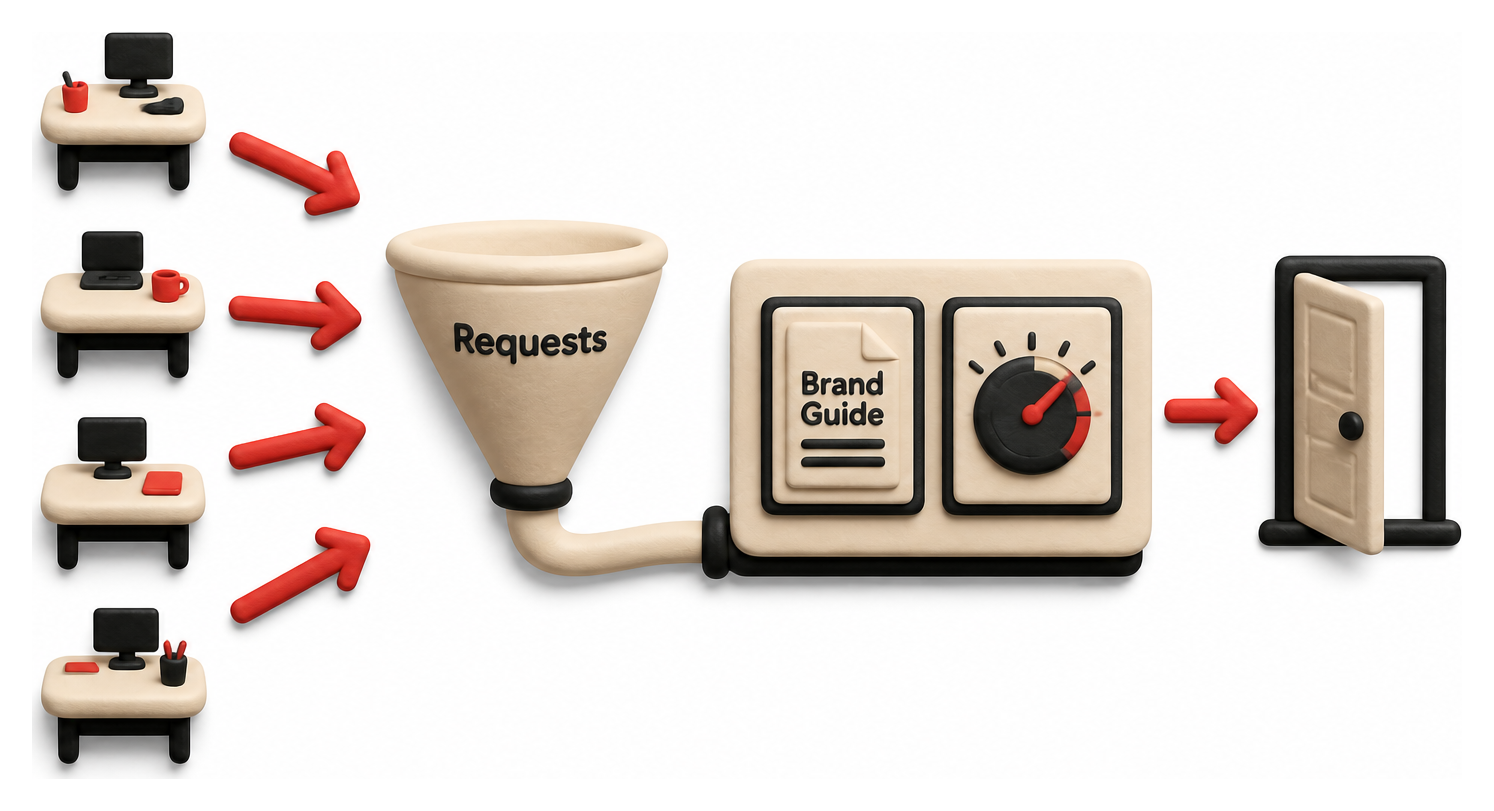
- Audit current request volume and type before shopping. Compare the subscription's monthly fee with recent freelance spending for comparable work, accounting for scope, revision needs, and turnaround; teams with steady weekly demand across multiple formats are more likely to benefit from a subscription.
- Match the delivery model to required turnaround. A single-operator model like DesignJoy's, averaging 48-hour delivery on one active request, suits teams with modest, non-urgent volume; teams needing several concurrent workstreams should evaluate active-request caps closely, since Penji's Business tier supports one active project while its Agency tier supports three [1].
- Request the vendor's current brand guidelines intake process during a sales call, and treat the thoroughness of that intake as a proxy for how seriously the vendor treats consistency, not just throughput.
- Centralize all requests through one dashboard or intake channel, even if multiple marketing team members will submit requests, to avoid duplicate or conflicting briefs reaching the design queue.
- Build or update the brand style guide before, not after, onboarding, given that Frontify's data shows guideline creation alone takes an average of "1.5 months" [67]; starting a subscription without a current guide forces the design team to guess at brand rules on early requests.
- Establish an internal approval step before any asset ships externally, regardless of how experienced the outsourced designer becomes, since even a well-briefed external team lacks the tacit organizational context an in-house reviewer holds.
- Track actual turnaround and revision counts against the vendor's stated service levels during a trial period; where available, use a vendor's money-back guarantee window rather than accepting marketing claims at face value.
- Reassess plan tier quarterly against actual submitted-request volume, since most vendors price by active-request capacity or project count rather than total design hours, meaning underused capacity is a pure cost leak.
- Name an internal brand governance owner, distinct from whoever manages the vendor relationship day to day, consistent with Marq's finding that effective governance "must include legal, compliance, sales, communications, and key business units" rather than resting solely with the person submitting design requests [68].
- Audit consistency across channels, not just within the vendor relationship, since Adobe's guidance that messaging "needs to be consistent across all marketing channels and touch points" applies equally to assets a subscription vendor never touches, such as sales decks or customer support materials [64].
Buyers evaluating enterprise-tier providers such as Superside face a somewhat different calculus, since the product being purchased is closer to an outsourced creative department, complete with a project manager, than a queue-based design utility; Superside's own materials describe scenarios in which a single account escalated a client's "look and feel by the power of 70" after consolidating thirteen previously disconnected sub-brands into one governed system [69], an outcome that reflects brand-system consolidation work well beyond simple design execution. Enterprise buyers can similarly weigh Superside's 4.5-out-of-5 G2 rating against its 115-review sample size when benchmarking a prospective managed-team engagement [7].
- 01Audit Request Volume
Compare the subscription's monthly fee against recent freelance spending before choosing a vendor.
- 02Match Delivery Model
Evaluate active-request caps and turnaround claims against how many concurrent workstreams the team needs.
- 03Build Style Guide First
Update the brand style guide before onboarding, since guideline creation alone takes an average of 1.5 months.
- 04Require Internal Approval
Establish an internal approval step before any asset ships externally, regardless of designer experience.
- 05Reassess Plan Tier
Reassess plan tier quarterly against actual submitted-request volume so underused capacity doesn't become a cost leak.
- 06Assign Governance Owner
Name an internal brand governance owner distinct from whoever manages the day-to-day vendor relationship.
Following this sequence turns a subscription into an actual consistency system, not just a production queue.
Skipping the governance steps produces faster, cheaper, and still-inconsistent output.
Data Analysis and Evidence
The quantitative picture assembled across vendor pricing pages, government wage data, and independent review platforms is summarized here to make cross-comparison explicit. On pricing, the six researched providers span from Penji's $499/mo entry tier through ManyPixels' $2,599/mo top "Design team" tier [56] up to Superside's $30,000/mo Dedicated Plan, a roughly sixty-fold range within a single product category. ManyPixels reports having delivered more than "1,291" design projects on its own pricing page's live statistics display [70], a vendor-published operational figure rather than an independently audited one. Kimp's own "about us" page traces the underlying design team's operating history back to 2003, six years before the earliest of the other five vendors examined in this report launched a subscription product; that operating history, predating the "subscription design" label itself, is one reason some buyers evaluate a vendor's underlying production team as much as its current subscription packaging [19].
Wage benchmarks anchor the in-house comparison firmly. BLS data show self-employed workers making up 18 percent of the graphic design workforce as of the most recent measurement [71], underscoring that freelancing and, by extension, outsourced models like design subscriptions, already represent a meaningful share of how design work gets done, not a fringe alternative to in-house employment. PayScale's $21 to $85 hourly range for freelance graphic designers [50] also spans nearly the entire monthly cost of an SMB-tier subscription plan if a buyer purchases only a handful of hours, reinforcing why teams with steady, moderate volume tend to find the flat-rate model more predictable than accumulating freelance invoices.
On review-platform sentiment, review volume itself is informative: Design Pickle's 226 G2 reviews and Penji's 188 [38] represent far larger evaluation samples than Kimp's 15 or ManyPixels' 25. The latter two listings therefore provide less stable signals than larger review samples. Ratings across the five cited G2 listings range from 4.0 to 4.9 out of 5. They describe reviewers' experiences with those vendors, not the subscription-design category as a whole, and are not a representative basis for a category-wide customer-satisfaction conclusion. This report could not independently verify Trustpilot, Clutch, or Capterra scores due to bot-detection barriers encountered on all three platforms during research.
Funding and financial data provide a rough proxy for market validation. Superside's $30 million Series A, closed in December 2021 and co-led by Prosus Ventures and Lugard Road Capital [72], followed a period in which the company, then still called Konsus, "had picked up only $5.5 million" in its first six years [21], suggesting investor interest in the subscription-creative model accelerated meaningfully in the early 2020s. At the opposite scale, DesignJoy's revenue is reported by business-data aggregator Latka to have reached "$3.1M" cumulatively with the company "previously report[ing] $1.5M in 2023" [73]; these figures are founder-self-reported rather than independently audited and should be treated as directional rather than precise, and the same aggregator lists the company at roughly one employee even at that revenue scale [27]. The same Marq survey discussed above found 45 percent of customers expect strong design across marketing and sales collateral, a bar that applies equally to in-house, agency, and subscription-produced assets [59].
On the brand-consistency side, the data converge on a consistent story: guidelines exist in most organizations but go under-enforced or under-adopted, the resource cost of maintaining and searching for brand assets is measurable, and the majority of surveyed marketers already lean on external production help. Lucidpress's underlying survey methodology, drawn from more than 400 brand management professionals rather than a single-digit sample, gives its 10 to 20 percent growth estimate more statistical weight than many smaller vendor-run surveys in the category [14]. None of the surveyed data sources directly measured whether outsourcing production specifically to a subscription design vendor, as opposed to a traditional agency or freelancer, produces measurably better consistency outcomes; that remains an evidence gap in the public research record as of July 2026, and claims to the contrary made by any individual vendor should be read as unverified marketing positioning rather than established fact.
buyers who onboard a subscription service without first codifying brand rules risk simply outsourcing their inconsistency at a faster production pace.
Case Studies and Real-World Examples
Superside and PointCard: Iterative Ad Testing at Scale
Fintech card company PointCard used Superside's creative production to run iterative performance-marketing tests, reporting a "240% increase in CTR and a click-to-install conversion rate growth of 275%" according to Superside's published account of the engagement [74]. As with all vendor-published case studies, these figures come from the vendor's own marketing materials rather than an independent audit and should be read as an illustration of achievable outcomes under favorable conditions rather than a typical or guaranteed result.
Superside and Kins: Physical Therapy Startup Ad Performance
Digital physical therapy startup Kins reported that human-centric, iteratively tested ad creative through Superside helped it move on-site conversion rates "from 1-2% to up to 4%" [75], while Growth Lead Paul Worrell is quoted crediting the partnership with "our cost-per-result dropping by 20-40%" on Facebook advertising specifically [76].
Superside and TransACT: Consolidating Thirteen Sub-Brands
K-12 software provider TransACT used Superside to unify thirteen previously disconnected sub-brands into a single design system, with the company describing the resulting jump in creative capacity as having "escalated our look and feel by the power of 70" [69]. TransACT's Director of Sales and Marketing, Alyssa Thornley, also drew a direct contrast with prior vendors on service reliability, stating that inconsistent delivery "was not the case with Superside at all" [77], an outcome that speaks directly to the brand-consistency thesis of this report: consolidating fragmented sub-brand identities into one managed system is a governance outcome, not merely a production one.
Superside and Forter: Scaling Motion Production and Live Brand Experiences
Fraud-prevention fintech Forter used Superside for both ongoing video production and a large-scale physical brand activation. Brand Design Manager Kayla Parker credited the partnership with capacity growth in a demanding creative category, stating "Superside has been huge in scaling our video production" for Forter's constellation-based brand identity [78]. For its IMPACT 2024 conference, Superside's team reportedly "transformed Center415 into a living, breathing New York microcosm in just three weeks," converting a 30,000-square-foot venue on a compressed timeline [79], illustrating that enterprise-tier subscription vendors can extend well beyond digital graphic design into physical event and brand-experience production.
Superside and Satair: Extending an Internal Marketing Team
Aircraft-parts distributor Satair used Superside as an extension of a lean internal marketing function rather than a replacement for it. Marketing Project Manager Hardeep Kaur described the working relationship in terms of delegated oversight, noting that her "direct Superside project manager does a lot of the heavy lifting and quality control" on Satair's design projects [62]. Superside's published account of the relationship separately reports an "Average NPS for design projects" figure of 100, a self-reported satisfaction metric rather than an independently benchmarked score [80].
Penji and Agency Partner Linear: Paid-Conversion Gains
Rather than a direct Penji customer story, this case involves Penji itself as a client of performance-marketing agency Linear, which reported that "Penji reduced their cost per conversion by 47% and increased total conversions by 714%" through Linear's campaign work [81]. Penji co-founder and CEO Khai Tran is quoted describing the creative output as "far better than any other agency we've worked with" [45], illustrating that even a subscription design vendor itself relies on outside specialists for certain functions (in this case, paid media strategy) that fall outside its own core service.
Kimp and WGAN: Sustained Asset Production for a Niche Community
Real estate photography network WGAN (WorldWide ERC Aerial and Ground Network) has used Kimp on an ongoing basis, with founder Dan Smigrod crediting the partnership with producing "500+ digital assets for WGAN" over the course of the engagement [36], an example of a subscription relationship sustained long enough to accumulate a large, presumably style-consistent asset library rather than a one-off engagement.
Tropicana's 2009 Packaging Redesign: A Cautionary Consistency Failure (Not a Subscription-Design Case)
Not every relevant case study involves an outsourced design vendor; Tropicana's 2009 redesign of its Pure Premium orange juice packaging, which replaced the recognizable straw-in-orange imagery with a more minimalist design, is frequently cited in branding literature as a consistency failure with measurable financial consequences. Trade coverage reports that "sales dropped by 20%, and this spectacular decrease in sales represented a loss of 30 million dollars" in the weeks following the redesign's rollout [18], despite the company having "invested 35 million dollars in an advertising campaign that promoted the new packaging" [82]. Tropicana reverted to the original packaging within weeks. The case is instructive precisely because it involved a well-resourced internal and agency design process, not a failure of production capacity; it illustrates that consistency failures often originate in governance and customer-recognition decisions that no design vendor, subscription-based or otherwise, can prevent on a client's behalf.
Franchise and Multi-Location Brand Consistency: D1 Training, Reinhart Realtors, and First Team Real Estate
Three additional named cases, documented by design-platform vendor Marq rather than a subscription design service, illustrate the governance side of the consistency problem in multi-location businesses. Fitness franchise D1 Training, with more than 25 locations, struggled because individual franchisees sourced their own local designers, with the company noting "we had no control over what they were pushing out" before adopting locked brand templates [83]. Ann Arbor-based brokerage Reinhart Realtors reported saving "320 hours of work saved per week" firm-wide after adopting lockable brand templates that let individual agents self-serve on-brand marketing materials without commissioning custom design each time [66]. Southern California's First Team Real Estate, with more than 2,200 agents, described a similar pre-fix problem in which "off-brand, rogue content was doing First Team and Sandy Chang's team zero favors" [84]. None of these three cases used an outsourced design subscription; they instead centralized brand asset creation through templated systems, underscoring that governance tooling and outsourced production are complementary strategies, not substitutes for one another.
Table 3 below consolidates the quantified outcomes from the vendor-attributed case studies discussed above.
| Case | Provider/Platform | Reported Outcome | Source |
|---|---|---|---|
| PointCard | Superside | 240% CTR increase; 275% install-conversion growth | Superside blog [85] |
| Kins | Superside | Conversion rate 1-2% to 4%; cost-per-result down 20-40% | Superside customer story [75] |
| TransACT | Superside | "70x" creative capacity after 13-sub-brand consolidation | Superside blog [69] |
| Forter | Superside | 30,000 sq. ft. conference venue transformed in three weeks | Superside blog [79] |
| Penji (via agency Linear) | Penji / Linear | Cost per conversion down 47%; conversions up 714% | Linear case study [81] |
| WGAN | Kimp | 500+ digital assets delivered over engagement | Kimp case study [36] |
| Reinhart Realtors | Marq (brand templates, not a design subscription) | 320 hours of work saved per week firm-wide | Marq case study [66] |
| D1 Training | Marq (brand templates, not a design subscription) | Resolved franchisee brand drift via locked templates | Marq case study [83] |
| First Team Real Estate | Marq (brand templates, not a design subscription) | Eliminated "rogue" off-brand agent content across 2,200+ agents | Marq case study [84] |
The pattern across every vendor-published case in this table is consistent: reported outcomes are impressive but self-selected and self-reported by the vendor or its client in a promotional context, with no independent third-party audit available for any of the percentage figures. Buyers should treat each as evidence that strong outcomes are achievable under the right conditions, not as a statistically representative expectation for any given engagement.
Implications and Future Directions
Several trends are likely to shape how subscription design services intersect with brand consistency needs over the next several years. First, artificial intelligence is already reshaping both sides of the market: BLS explicitly flags that AI design tools "may reduce the need for companies to contract with freelance graphic designers" [48], and several subscription vendors, including Superside, already market AI-assisted production; Superside's own materials describe producing "over 75 image options" for a single client's ad-creative refresh using AI-enhanced workflows [86]. This raises an open question for brand consistency specifically: AI-generated variation can produce volume quickly, but volume without governance is precisely the failure mode Frontify's survey data documents, where a meaningful share of created assets go unused and asset sprawl itself becomes a cost center rather than a brand asset. Adobe's broader point that messaging consistency spans "all marketing channels and touch points" applies equally to the growing number of AI-generated variants a subscription vendor might produce, since volume without a consistent voice across those channels can dilute a brand as easily as visual inconsistency can [64].
Second, the market's price segmentation is likely to persist rather than converge, given how structurally different the SMB and enterprise tiers are. A $499/mo Penji-style plan and a $30,000/mo Superside Dedicated Plan are not competing for the same buyer; the former targets solo marketers and small businesses needing steady output on a tight budget, while the latter targets enterprises effectively outsourcing an entire creative department, project management included. Buyers should resist comparing headline prices across tiers without normalizing for the very different scope, oversight, and specialist access each tier includes. Superside's own account of its 2021 raise frames the capital as intended to expand its creative-talent network rather than pivot the business model, a detail consistent with the company's continued positioning as a managed subscription rather than a traditional agency roll-up [22].
Third, the review-platform data gathered for this report span G2 ratings from 4.0 to 4.9 across five cited vendor listings, with sample sizes from 15 to 226 reviews. The data can inform diligence on those providers, but it is not representative of the subscription-design category. The report's inability to retrieve Trustpilot, Clutch, or Capterra data due to bot-detection barriers is also a reminder that buyers conducting vendor diligence should expect to do first-hand reference checks rather than relying solely on aggregated review sites. By contrast, Kimp's 16 reviews and ManyPixels' 30 reviews on G2 mean either rating could shift meaningfully with just a handful of new submissions, a caveat that applies to any small-sample review comparison in this fast-growing category [42] [40]. The wide variance in company scale within the category, from DesignJoy's single-operator model reportedly generating $3.1 million cumulatively [73] to Superside's venture-backed, hundreds-of-employees operation, also means buyers should expect meaningfully different business continuity risk depending on which tier of the market they select; a solo-operator subscription carries obvious key-person risk that a managed-team model does not.
Fourth, and most directly relevant to the brand-consistency framing of this report, the evidence strongly suggests that outsourced design capacity and brand governance are complementary rather than substitutable investments. The strongest documented consistency outcomes in this research, Reinhart Realtors' 320 hours saved per week and D1 Training's resolution of franchisee brand drift, came from centralized template and governance systems, not from outsourced design subscriptions. Tropicana's 2009 packaging failure, discussed above, remains a useful cautionary reference precisely because it predates the AI-assisted design era; Tropicana's separate $35 million investment in advertising the failed redesign, on top of the estimated $30 million sales loss, underscores that consistency failures carry compounding costs beyond lost revenue alone, including the sunk cost of campaigns built around the inconsistent asset, and a governance failure of that kind is, if anything, easier to reproduce faster today, since AI-accelerated production removes the natural rate-limiting effect that manual design work once imposed on how quickly an off-brand asset could reach the market [82]. The clearest interpretation is that a subscription design service is best understood as a production capacity solution that removes hiring and scheduling friction, while brand consistency itself remains primarily a governance problem requiring guidelines, templates, and approval workflows that a company must build and maintain regardless of who executes the resulting designs.
Frequently Asked Questions (FAQs)
What is a subscription design service?
A subscription design service is a flat-monthly-fee arrangement, sometimes called "unlimited design" or "design as a service" (DaaS), in which a client submits an unlimited number of design requests through a queue and receives output from an assigned designer, pooled team, or managed creative pod, depending on the vendor and plan tier, as described in the definitions above [25].
How much does an unlimited design subscription for brands typically cost?
As of July 2026, published entry pricing runs from $499/mo at the small-business end to $4,995/mo for solo-operator DesignJoy and $15,000 to $30,000+/mo for enterprise-tier Superside, as summarized in Table 1 above.
Is "unlimited" design really unlimited?
Not in a parallel-production sense. Vendors cap simultaneous active requests and work through a sequential queue; Kimp discloses that even its most capable tier handles "2 tasks in progress" at a time with roughly two to two and a half hours of daily allocation [13], and DesignJoy is built around processing one request at a time rather than a parallel queue. "Unlimited" refers to total requests and revisions over time, not simultaneous throughput.
How do subscription design services help maintain brand consistency across marketing channels?
Primarily through designer continuity (the same person or pod learns the brand over repeated requests), centralized request intake that functions as a lightweight asset-management layer, and, at the enterprise tier, dedicated project management that actively enforces brand rules, as outlined earlier in this report. They do not create brand guidelines on a company's behalf; buyers must supply and maintain those separately, a point Marq's own governance framework makes directly when it argues that effective governance "must include legal, compliance, sales, communications, and key business units" [68].
Design as a service (DaaS) vs. an in-house design team: which is cheaper?
For steady, moderate-volume needs, SMB-tier subscriptions ($499 to roughly $2,600/mo) are typically cheaper than a full-time hire, given that BLS puts the median in-house graphic designer's salary alone at roughly $5,108/mo [8] before benefits and overhead. For very high, sustained volume or work requiring deep institutional brand knowledge, an in-house hire or an enterprise-tier managed team may prove more cost-effective per unit of output over time.
What does flat-rate design subscription pricing for marketing teams usually include?
Typically unlimited requests and revisions within an active-request cap, a dedicated or pooled design resource, and a stated (though unaudited) turnaround target, generally one to four business days depending on task complexity and vendor, as summarized in Table 1 above.
Can an outsourced or subscription design team fully replace a marketing agency?
Only for production-focused work. Agencies typically bring strategic planning, media buying, and campaign architecture in addition to design execution; several of the case studies in this report, including Penji's own use of agency Linear for paid-media strategy, show that even design subscription companies themselves still engage agencies for functions outside core design production.
Do subscription design services show measurable marketing performance results?
Some do, though evidence is vendor-published rather than independently audited. Superside's case study with digital physical therapy startup Kins reported conversion rate improvements "from 1-2% to up to 4%" after iterative, human-tested ad creative [75], though such figures should be read as achievable outcomes under favorable conditions rather than typical results across every engagement.
How does an enterprise-tier design subscription differ from a small-business plan beyond price?
Beyond the higher minimum, enterprise plans typically include a named project manager, multi-specialist teams, and support for formats a small-business plan rarely covers, such as live event and physical brand-experience production; Superside's work transforming a 30,000-square-foot venue for client Forter in three weeks is one documented example [79].
Why do so many brands struggle with consistency even when they have a designer or vendor in place?
Largely because guidelines and asset libraries decay without active maintenance rather than because of a production shortfall. Marq's survey data found 85 percent of organizations already have brand guidelines but only a minority enforce them consistently, and Frontify's survey similarly found that a meaningful share of created marketing assets go unused, as discussed above, evidence that the bottleneck is often governance and organization rather than raw design capacity.
Conclusion
Subscription design services occupy a genuine, cost-competitive middle tier between full-time in-house hiring and traditional agency retainers, with SMB-focused plans priced well below the fully loaded cost of a single median-wage in-house designer and enterprise-tier managed plans priced to substitute for an entire outsourced creative department. The category's core value proposition, predictable flat-rate pricing for ongoing design output, is well documented across the six providers examined in this report, from Penji's $499/mo entry tier to Superside's $30,000/mo Dedicated Plan. The cited G2 listings show favorable, time-sensitive ratings for those individual providers, ranging from 4.0 to 4.9 out of 5; they do not establish category-wide customer satisfaction. What the evidence does not support is the assumption that outsourcing design production to a subscription vendor automatically solves brand consistency. The strongest documented consistency wins in this research, from Reinhart Realtors' 320 hours saved weekly to D1 Training's resolution of franchisee brand drift, came from centralized governance and templating systems, while the clearest consistency failure examined, Tropicana's 2009 packaging redesign, occurred despite a well-resourced internal design process. Brand consistency remains fundamentally a governance discipline: guidelines that are actually adopted and enforced, asset libraries that are actually maintained, and approval workflows that are actually followed. A subscription design service is best evaluated as a capable, cost-efficient production engine that can execute against that governance system faster and more predictably than ad hoc freelance or in-house hiring, but marketing teams that skip the governance work and expect a monthly design subscription to manufacture consistency on its own are likely to end up with faster, cheaper, and still-inconsistent output.
External Sources (86)
About
Tapflare
Tapflare in a nutshell Tapflare is a subscription-based “scale-as-a-service” platform that hands companies an on-demand creative and web team for a flat monthly fee that starts at $649. Instead of juggling freelancers or hiring in-house staff, subscribers are paired with a dedicated Tapflare project manager (PM) who orchestrates a bench of senior-level graphic designers and front-end developers on the client’s behalf. The result is agency-grade output with same-day turnaround on most tasks, delivered through a single, streamlined portal.
How the service works
- Submit a request. Clients describe the task—anything from a logo refresh to a full site rebuild—directly inside Tapflare’s web portal. Built-in AI assists with creative briefs to speed up kickoff.
- PM triage. The dedicated PM assigns a specialist (e.g., a motion-graphics designer or React developer) who’s already vetted for senior-level expertise.
- Production. Designer or developer logs up to two or four hours of focused work per business day, depending on the plan level, often shipping same-day drafts.
- Internal QA. The PM reviews the deliverable for quality and brand consistency before the client ever sees it.
- Delivery & iteration. Finished assets (including source files and dev hand-off packages) arrive via the portal. Unlimited revisions are included—projects queue one at a time, so edits never eat into another ticket’s time.
What Tapflare can create
- Graphic design: brand identities, presentation decks, social media and ad creatives, infographics, packaging, custom illustration, motion graphics, and more.
- Web & app front-end: converting Figma mock-ups to no-code builders, HTML/CSS, or fully custom code; landing pages and marketing sites; plugin and low-code integrations.
- AI-accelerated assets (Premium tier): self-serve brand-trained image generation, copywriting via advanced LLMs, and developer tools like Cursor Pro for faster commits.
The Tapflare portal Beyond ticket submission, the portal lets teams:
- Manage multiple brands under one login, ideal for agencies or holding companies.
- Chat in-thread with the PM or approve work from email notifications.
- Add unlimited collaborators at no extra cost.
A live status dashboard and 24/7 client support keep stakeholders in the loop, while a 15-day money-back guarantee removes onboarding risk.
Pricing & plan ladder
| Plan | Monthly rate | Daily hands-on time | Inclusions |
|---|---|---|---|
| Lite | $649 | 2 hrs design | Full graphic-design catalog |
| Pro | $899 | 2 hrs design + dev | Adds web development capacity |
| Premium | $1,499 | 4 hrs design + dev | Doubles output and unlocks Tapflare AI suite |
All tiers include:
- Senior-level specialists under one roof
- Dedicated PM & unlimited revisions
- Same-day or next-day average turnaround (0–2 days on Premium)
- Unlimited brand workspaces and users
- 24/7 support and cancel-any-time policy with a 15-day full-refund window.
What sets Tapflare apart
Fully managed, not self-serve. Many flat-rate design subscriptions expect the customer to coordinate with designers directly. Tapflare inserts a seasoned PM layer so clients spend minutes, not hours, shepherding projects.
Specialists over generalists. Fewer than 0.1 % of applicants make Tapflare’s roster; most pros boast a decade of niche experience in UI/UX, animation, branding, or front-end frameworks.
Transparent output. Instead of vague “one request at a time,” hours are concrete: 2 or 4 per business day, making capacity predictable and scalable by simply adding subscriptions.
Ethical outsourcing. Designers, developers, and PMs are full-time employees paid fair wages, yielding <1 % staff turnover and consistent quality over time.
AI-enhanced efficiency. Tapflare Premium layers proprietary AI on top of human talent—brand-specific image & copy generation plus dev acceleration tools—without replacing the senior designers behind each deliverable.
Ideal use cases
- SaaS & tech startups launching or iterating on product sites and dashboards.
- Agencies needing white-label overflow capacity without new headcount.
- E-commerce brands looking for fresh ad creative and conversion-focused landing pages.
- Marketing teams that want motion graphics, presentations, and social content at scale. Tapflare already supports 150 + growth-minded companies including Proqio, Cirra AI, VBO Tickets, and Houseblend, each citing significant speed-to-launch and cost-savings wins.
The bottom line Tapflare marries the reliability of an in-house creative department with the elasticity of SaaS pricing. For a predictable monthly fee, subscribers tap into senior specialists, project-managed workflows, and generative-AI accelerants that together produce agency-quality design and front-end code in hours—not weeks—without hidden costs or long-term contracts. Whether you need a single brand reboot or ongoing multi-channel creative, Tapflare’s flat-rate model keeps budgets flat while letting creative ambitions flare.
Disclaimer
This document is provided for informational purposes only. No representations or warranties are made regarding the accuracy, completeness, or reliability of its contents. Any use of this information is at your own risk. Tapflare shall not be liable for any damages arising from the use of this document. This content may include material generated with assistance from artificial intelligence tools, which may contain errors or inaccuracies. Readers should verify critical information independently. All product names, trademarks, and registered trademarks mentioned are property of their respective owners and are used for identification purposes only. Use of these names does not imply endorsement. This document does not constitute professional or legal advice. For specific guidance related to your needs, please consult qualified professionals.