
Tapflare Article
How to Scale Creative Output Without Hiring an In-House Team
Inside this article
- 01Introduction and Background
- 02The Five Ways to Scale Creative Output Without Hiring
- 03Outsourcing Creative Production vs In-House Teams: The Economics
- 04Managing Freelance and Fractional Creative Teams
- 05AI-Assisted Creative Production at Scale
- 06Implementation Guidance: Building a Scalable Creative Operating Model
- 07Data Analysis and Evidence
- 08Case Studies and Real-World Examples
- 09Implications and Future Directions
- 10Frequently Asked Questions (FAQs)
- 11Conclusion
Companies facing rising demand for marketing and creative content are increasingly choosing not to solve the problem by hiring. Generative artificial intelligence (AI) tools have roughly doubled content production demand for 96% of marketers surveyed by Adobe and research firm Advanis in October 2025 [1], while the cost and speed of traditional hiring keep working against expansion. The Society for Human Resource Management (SHRM) reported in 2026 that median cost-per-hire for nonexecutive roles reached $1,300 and executive cost-per-hire reached $15,000, with a median 39-day time-to-fill for nonexecutive positions [2] [3]. Against that backdrop, four scaling models have matured into credible alternatives to headcount growth: freelance marketplaces, subscription-based "creative-as-a-service" platforms, fractional creative leadership, and AI-assisted production tools, each analyzed in detail in this report.
The freelance option has grown substantially. Upwork's investor-reported research found that 64 million Americans freelanced in 2023, or 38% of the entire workforce, contributing $1.27 trillion in annual earnings [4] [5]. By July 2026, Upwork's own Future Workforce Index reported that the share of skilled U.S. knowledge workers who freelance jumped from 28% to 38% in a single year, with generative AI and creative production contract starts up 90% year-over-year [6]. Subscription creative-as-a-service platforms have also become mainstream, with Penji's flagship "Marketing & Ads" plan priced at $995 per month and explicitly marketed for teams needing production "without adding headcount" [7], and DesignJoy, a single-founder subscription service, listing its Monthly Club tier at $4,995 as of July 2026 [8].
The economics behind these choices are measurable. The Association of National Advertisers (ANA) found that 82% of its members now run an in-house agency, yet 92% of those same organizations still work with an external agency simultaneously, and marketers rank "cost efficiencies" as the top-cited benefit of the in-house model [9] [10]. Gartner's 2024 CMO Spend Survey of 395 chief marketing officers found average marketing budgets fell to 7.7% of company revenue, down from 9.1% in 2023, intensifying pressure to do more with the same or shrinking resources [11].
Real-world results from named organizations illustrate the range of outcomes. Amazon's home-goods creative operations team used on-demand design platform Superside to save 345 hours of internal designer time and deliver 1,092 assets across 20 projects in three months without expanding its eight-person core team [12]. Expedia Group's five-person brand design team adopted Canva Enterprise and now saves more than 7,800 design hours annually, with its art director describing the effect as feeling "like we have a team of 50 designers instead of only five" [13] [14]. This report walks through the taxonomy of scaling models, the underlying cost and market data, nine named case studies, and practical implementation guidance for building a creative operating model that grows output without growing payroll, while also flagging emerging risks, including Harvard Business Review's July 2026 warning that unmanaged AI-generated content can create "brand debt" that erodes consistency across channels [15].
Introduction and Background
Creative and marketing teams are being asked to produce more content, in more formats, for more channels, on shorter timelines, without a corresponding increase in staff. Adobe's October 2025 survey of more than 400 creative professionals and 400 marketers, conducted with research firm Advanis, found that content demand has doubled for 96% of marketers, with nearly two-thirds reporting their teams are struggling to keep pace [1]. At the same time, adding headcount has become slower and more expensive relative to the value it delivers in a single quarter. SHRM's 2026 recruiting benchmark data puts the median cost-per-hire for a nonexecutive role at $1,300, up marginally from $1,200 in 2025, and executive cost-per-hire at $15,000, a considerable jump year over year [16]. Those figures cover only the direct costs of sourcing and recruiting; they exclude the fully loaded cost of the position itself. The US Bureau of Labor Statistics (BLS) reported that as of March 2026, benefit costs made up 30.1% of total private-industry employer compensation, on top of an average $32.60 hourly wage, meaning benefits alone added roughly $14.01 per hour to every position [17].
"Scaling creative output without hiring" describes a family of operating models that decouple creative production volume from permanent payroll growth. This report treats the term broadly: it covers freelance marketplaces (Upwork, Fiverr Pro, Toptal), subscription-based "creative-as-a-service" platforms (Design Pickle, Superside, Penji, Kimp, DesignJoy), fractional creative leadership (part-time creative directors and chief marketing officers), AI-assisted production tools (Adobe Firefly, Canva, Jasper, Midjourney), and traditional agency retainers used more surgically alongside the others. None of these models is mutually exclusive; most organizations profiled in this report combine two or more.
The scale of the underlying shift is measurable at the market level. Mordor Intelligence sizes the global creative design services market, covering brand identity, social and performance creative, packaging, and campaign design, at $56.22 billion in 2026, growing to $82.85 billion by 2031 at a compound annual growth rate (CAGR) of 8.06%, and explicitly names "in-housing and self-serve tools" as a factor pressuring traditional agency pricing [18].
At the same time, Upwork's July 2026 Future Workforce Index found that generative AI and creative production work is now one of the fastest-growing categories of freelance contract activity on its platform, up 90% year over year [19]. The remainder of this report examines each scaling model in turn, quantifies the cost and market data behind the shift, reviews nine named case studies, and closes with practical guidance for building a creative operating model that scales output rather than payroll, as of July 2026.The Five Ways to Scale Creative Output Without Hiring
Five distinct operating models let organizations increase creative throughput without adding full-time staff. They differ along cost structure, turnaround speed, quality control, and the degree of managerial overhead required, and most mature creative operations combine at least two.
Freelance Marketplaces
Freelance marketplaces connect companies directly with independent creative professionals for project-based or ongoing work. Upwork charges freelancers a variable service fee ranging from 0% to 15% of earnings across contract types, a structure that replaced its older flat-tier fee model [20]. Fiverr Pro operates as a vetted layer above Fiverr's general marketplace, with in-house evaluators screening freelancers on skills, portfolio quality, and client track record before they can list services [21]. Toptal goes further, accepting fewer than 3% of applicants after a screening process that takes three to eight weeks to complete, positioning itself around exclusivity and depth of vetting rather than marketplace breadth [22] [23].
Demand for this model is not marginal. Nearly half (47%, or roughly 30 million professionals) of all US freelancers provide knowledge services such as marketing, IT, and computer programming, according to Upwork's investor-reported 2023 study [24], and an additional 23% (14.7 million professionals) create influencer-style content [25]. On the buyer side, Fiverr Pro's 2024 survey of marketing executives found that 69% reported increased freelancer utilization that year, and 63% of marketing leaders now engage freelancers on at least one out of every four projects [26] [27].
Subscription Creative-as-a-Service Platforms
A second model wraps a pool of vetted creative talent inside a flat monthly or quarterly subscription, promising unlimited (or high-volume) requests instead of hourly billing. Design Pickle, one of the category's originators, moved to a custom, flat-rate quote model in 2025, billed only on quarterly or annual cycles, with most requests returned in one to two business days [28] [29]. Penji publishes tiered monthly pricing starting at $499 for its Business plan, rising to $995 for its "Marketing & Ads" plan (explicitly marketed for teams that need production "without adding headcount") and $1,995 for its Agency plan, with most projects delivered within one business day using full-time staff across more than 20 countries rather than freelancers [30] [7] [31] [32] [33].
DesignJoy, founded in 2017, is run as a solo-operator subscription service, an extreme version of scaling without hiring in which a single freelancer serves an entire client roster; as of July 2026 its live pricing page listed a Monthly Club tier at $4,995, discounted from $5,995 under a "lifetime discount" banner, with an average delivery time of two business days [34] [35]. Kimp advertises unlimited requests and revisions with turnaround as fast as 24 hours for simple tasks and two to four days for more complex work [36]; Kimp's official pricing page does not render numeric prices in static page content, though third-party software trackers report roughly $599 to $995 per month, a figure this report notes as vendor-unconfirmed. Superside frames its subscription model explicitly against the alternative of a traditional agency retainer, describing its offering as "far better value than holding an agency on retainer" [37]; Superside likewise does not publish dollar pricing, and third-party procurement trackers report a wide range, from roughly $10,000 to $100,000 per month depending on scope, a figure this report also treats as unverified against a primary source.
Fractional Creative Leadership
A third model replaces a full-time creative director or chief marketing officer (CMO) with a part-time, embedded executive who works across several client organizations simultaneously. Workforce-analytics firm Revelio Labs found that the share of new executive job postings referencing fractional work has roughly tripled since 2018, a trend it says accelerated after the COVID-19 pandemic [38]. Per Revelio Labs data reported by Newsweek, chief financial officer (CFO) and CMO roles are the two most prevalent fractional executive positions, at 18% and 14% of fractional postings respectively [39], meaning creative and marketing leadership together account for a meaningful share of the fractional executive market.
AI-Assisted Production Tools
A fourth model uses generative AI software to multiply the output of existing staff rather than replacing them with external talent. Adobe Firefly's consumer pricing, verified on the pricing fragment embedded in its official plans page, spans a Standard tier at $9.99 per month, a Pro tier at $19.99 per month, and a Premium tier at $199.99 per month [40] [41] [42]. Canva's Pro individual plan lists at $180 per year for one person on its official pricing page [43], while Jasper's Pro plan is priced at $69 per month billed monthly or $59 per month billed annually [44], and Midjourney's four subscription tiers run from $10 to $120 per month according to its official documentation [45]. Section four of this report covers adoption and productivity data for this model in depth.
Traditional Agency Retainers, for Contrast
The baseline against which all four alternatives above are typically measured is the traditional agency retainer, a recurring monthly fee that buys a defined bundle of ongoing creative capacity, structured to give a client predictable access to a team without the fixed cost of an in-house hire. This is precisely the gap the newer models above also target, often at lower cost and with more flexible scope.
Table 1 below summarizes the five models across the dimensions most relevant to a buyer choosing among them.
| Model | Typical Cost Structure | Typical Turnaround | Best Fit | Representative Providers |
|---|---|---|---|---|
| Freelance marketplace | Hourly or per-project, 0-15% platform fee on freelancer earnings [20] | Days to weeks, project-dependent | Specialized or one-off projects, spike coverage | Upwork, Fiverr Pro, Toptal |
| Subscription creative-as-a-service | Flat monthly or quarterly fee, roughly $500 to $5,000+/mo for SMB-focused platforms [30] [8] | 1-4 business days [29] | Continuous, high-volume design/content needs | Design Pickle, Penji, Kimp, DesignJoy, Superside |
| Fractional creative leadership | Part-time monthly retainer for a senior executive | Ongoing, embedded engagement | Strategic direction, brand leadership without a full-time hire | Independent fractional CDs/CMOs, HireFraction |
| AI-assisted production tools | Software subscription, roughly $10 to $200/mo per seat [40] [45] | Minutes to hours | Multiplying existing staff output, rapid iteration | Adobe Firefly, Canva, Jasper, Midjourney |
| Traditional agency retainer | Recurring monthly fee for a bundled service scope | Days to weeks, scope-dependent | Full-service strategic and creative partnership | Traditional marketing/creative agencies |
As the table shows, the newer models generally trade the strategic breadth of a full-service agency retainer for speed, predictable flat pricing, and lower minimum commitment, which is precisely the tradeoff that makes them attractive to organizations trying to add production capacity without adding permanent staff or agency-scale spend.
Outsourcing Creative Production vs In-House Teams: The Economics
The financial case for scaling without hiring rests on a comparison between the fully loaded cost of a permanent employee and the cost of the alternative models above. On the employee side, BLS's Occupational Employment and Wage Statistics put the median annual wage for a graphic designer at $61,300 in May 2024, an art director (the closest official BLS category to "creative director") at $111,040, a marketing manager at $161,030, and an advertising and promotions manager at $126,960 [46] [47] [48] [49]. None of these figures include benefits, which BLS separately reports made up 30.1% of total private-industry employer compensation as of March 2026, on top of an average $32.60 hourly wage and $46.60 total hourly compensation cost [50] [17]. Recruiting adds a further layer of cost before an employee produces a single deliverable: SHRM's 2026 benchmarking data puts median cost-per-hire at $1,300 for nonexecutive roles and $15,000 for executive roles, bundling job-board fees, referral costs, applicant travel, relocation, and recruiter time [51], and that hire typically takes 39 median calendar days to complete for a nonexecutive role [3].
Turnover compounds the calculation, since a departing creative employee triggers the entire cost stack again. LinkedIn's own talent-data analysis of roughly half a billion professionals found average cross-industry turnover of 10.9% annually, with Media and Entertainment among the highest-turnover industries at 11.4%, and marketing specialists within that sector churning at 19.8% [52] [53] [54]. In the United Kingdom, the Institute of Practitioners in Advertising's (IPA) Agency Census found total staff turnover across member agencies at 24.1% in the year to September 2024, and its 2025 census, published in early 2026, found turnover increasing again while employment at creative and non-media member agencies fell 14.3% year over year, from 14,775 to 12,659 staff [55] [56].
Despite these pressures, the ANA's own survey work shows most large marketers are not abandoning in-house teams outright; 82% of ANA members now operate an in-house agency, up from 78% previously, with "cost efficiencies" ranking as the single top-cited benefit [9] [57]. Critically, however, 92% of ANA members with an in-house agency still also work with at least one external agency [10], underscoring that scaling without hiring is, in practice, a hybrid strategy layered on top of a lean internal core rather than a wholesale replacement for one. Gartner's own labeled 2024 CMO Spend Survey data snapshot shows "agencies and services" still commanding between 20.4% and 22.9% of marketing budgets depending on business mix, even as overall marketing budgets fell to 7.7% of company revenue, down from 9.1% in 2023 [11].
Managing Freelance and Fractional Creative Teams
Scaling output without hiring shifts management effort from recruiting and retention toward briefing, vetting, and coordination. The scale of this shift is significant: Deloitte's research on contingent workforce management finds that nontraditional workers are "increasingly constituting 30%-50% of an overall workforce" at many organizations [58], meaning freelance and fractional management is no longer a peripheral skill for creative operations leaders but a core one.
Survey data on the practice is broadly positive, with important caveats. Wripple's 2025 Team Up Report found 97% mutual satisfaction between freelancers and the companies that hire them [59], and 81% of companies surveyed expect their freelance budgets to grow further, with 64% expecting to increase freelance hiring [60]. Fiverr Pro's 2024 survey similarly found that 99% of marketing executives who frequently use freelancers are likely to recommend the practice to peers [61], and roughly a quarter of surveyed executives (28%) said they turn to freelancers specifically to cover skill gaps left by layoffs or workforce reductions [62]. Yet Wripple's same report flags a persistent constraint: companies report being "thrilled with the quality of work freelancers deliver" while simultaneously "struggling to find enough qualified talent" at the volume they need [63], meaning sourcing and vetting, not satisfaction, is often the real bottleneck.
Best practices that emerge across these surveys and vendor documentation cluster around several themes:
- Vet before you brief. Platforms like Toptal and Fiverr Pro build formal screening into their business model [22] [21]; organizations sourcing talent directly should replicate that rigor with a standard portfolio review and a small paid trial project before committing to ongoing work.
- Write briefs a freelancer can execute without live back-and-forth. Because freelance relationships lack the daily context absorption of an in-house employee, a detailed creative brief substitutes for that context and reduces revision cycles.
- Centralize feedback in one asynchronous channel. Fragmented feedback across email, chat, and calls is a leading cause of freelancer turnaround delays reported anecdotally by creative-as-a-service platforms such as Design Pickle and Penji, both of which route all requests through a single project-management interface [32].
- Treat collaboration tooling as infrastructure, not overhead. Asana's Anatomy of Work research, based on a global survey of 9,615 knowledge workers, found that 55% of workers at organizations with strong cross-team collaboration report revenue growth over the prior three years, and 79% feel well prepared to respond to disruption, compared to weaker outcomes at less collaborative organizations [64] [65].
- Budget for onboarding time even without a formal hire. Fractional and freelance creative leaders still require ramp-up time to internalize brand guidelines and stakeholder dynamics; treating that ramp-up as zero-cost is a common planning error.
- Track cost per deliverable, not just monthly spend. Comparing the flat fee of a subscription platform or the hourly rate of a freelancer against the fully loaded cost of an equivalent in-house hire, calculated using BLS wage and benefits data, is the most defensible way to justify budget reallocation to finance stakeholders [17].
For fractional creative leadership specifically, the management dynamic differs from freelance project work in that the fractional executive is expected to own outcomes rather than individual deliverables. A case study of clinical documentation company ZyDoc, discussed in full later in this report, illustrates the point: its fractional creative director partnership was structured, in the client's words, as "an immediate business partner, which is exactly what we needed. Business partner first, artist and creative director second" [66], a framing that shapes how much strategic latitude, versus task-level direction, the arrangement requires.
AI-Assisted Creative Production at Scale
Generative AI tools represent the fastest-growing lever for scaling creative output without hiring, and adoption is now near-saturation among creative professionals specifically, even as broader enterprise rollout lags. McKinsey's 2025 Global AI Survey found that marketing and sales is the business function with the broadest generative AI adoption across all industries surveyed, and that 71% of companies now use generative AI in at least one business function on average [67] [68]. At the same time, McKinsey cautions that "nearly two-thirds of respondents say their organizations have not yet begun scaling AI" enterprise-wide, meaning individual-tool adoption is running well ahead of organization-wide process redesign [69].
Within creative teams specifically, adoption is close to universal. Adobe's October 2025 survey, conducted with research firm Advanis, found that 99% of creative professionals now use generative AI in some capacity, with 88% saying it helps them produce content faster and 87% saying it improves output quality [70] [71]. A follow-up Adobe/Advanis survey in April 2026 found that nearly nine in ten creatives say generative AI has made their work better, not just faster [72]. On the marketing side, Salesforce's tenth-edition State of Marketing report, surveying nearly 4,500 marketers, found that 75% of marketing organizations now use some form of AI, and 63% of marketers currently use generative AI specifically [73] [74].
The productivity case is quantified but modest relative to the adoption headlines. Adobe's GenStudio research found that AI users save an average of 116 minutes weekly on content creation, roughly 100 hours annually, and that AI adopters were 44% more likely to gain additional production budget than non-adopters [75] [76]. Adobe Firefly alone had generated more than 22 billion assets worldwide as of its April 2025 relaunch announcement, an indicator of the sheer production volume now flowing through AI tools rather than through additional human headcount [77].
That scale of output introduces a distinct risk that did not exist when volume was constrained by human capacity: unmanaged brand inconsistency. Harvard Business Review warned in July 2026 that AI can rapidly scale what it calls "brand debt," writing that "small inconsistencies that once affected a handful of customers can now spread" across every AI-generated asset simultaneously [15]. HBR's research found that companies with the lowest brand debt were 2.4 times more likely to exceed peer-average revenue growth after one year [78], and it specifically names "off-brand AI outputs" across channels as a source of what it terms "consistency debt" [79]. For organizations scaling output through AI tools, this means governance, brand guideline enforcement, and human review checkpoints become more important, not less, as production volume rises, a theme revisited in the Implications section below.
Implementation Guidance: Building a Scalable Creative Operating Model
Organizations that successfully scale creative output without hiring tend to follow a similar sequence, moving from audit to pilot to blended operating model rather than switching wholesale from an in-house team to an outsourced one overnight.
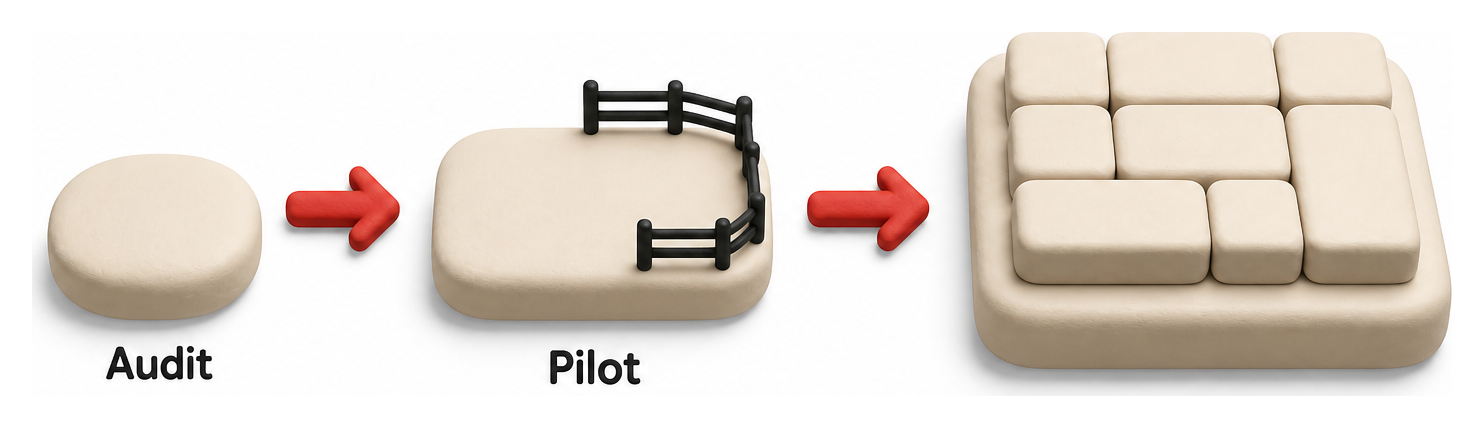
- Audit current output and bottlenecks first. Before selecting a model, quantify where creative requests currently stall: intake, briefing, production, or review. Design Pickle's own case studies, discussed in the next section, consistently show turnaround time, not raw design quality, as the primary constraint that outsourcing or AI tooling resolves.
- Match the model to the type of work, not the whole function. Repetitive, template-driven design (social graphics, ad variants, presentation decks) is well suited to subscription creative-as-a-service platforms or AI tools; strategic, brand-defining work (campaign concepts, rebrands) is better suited to fractional leadership or a retained agency relationship.
- Start with a bounded pilot and a fixed budget ceiling. Because subscription platforms like Penji and Design Pickle bill flat monthly or quarterly fees rather than open-ended hourly rates [30] [80], a 60-to-90-day pilot at the entry tier is low-risk relative to a permanent hire that costs a median $1,300 to $15,000 just to recruit [16].
- Keep a lean in-house core for brand governance. The ANA's finding that 82% of member marketers maintain an in-house agency even while using external partners [9] reflects a widely held view that someone internal must own brand consistency, especially as AI-generated volume rises and HBR's brand-debt research shows measurable revenue consequences for failing to do so [78].
- Build a single intake and feedback channel before scaling volume. Asana's global survey data linking strong cross-team collaboration to both revenue growth and disruption-readiness [64] suggests that process discipline, not just added capacity, is what converts outsourced or AI-assisted throughput into business results.
- Layer models rather than choosing one. The most common pattern across the case studies below is a subscription or AI tool handling volume, paired with a small in-house or fractional strategic layer, rather than any single model carrying the entire creative function.
- Re-audit quarterly as remote and hybrid dynamics evolve. A peer-reviewed Nature study by Stanford Graduate School of Business and Columbia Business School researchers found that videoconferencing measurably inhibits the production of creative ideas compared with in-person collaboration [81], with in-person teams generating 15% to 20% more ideas than teams meeting over video, according to Stanford GSB's own coverage of the research [82]. This is a relevant constraint for distributed freelance and fractional models specifically, and argues for periodic in-person strategy sessions even within an otherwise remote creative operating model.
Data Analysis and Evidence
The market data underlying this shift is drawn from several named research firms, each covering a different slice of the same underlying trend. Mordor Intelligence values the global creative design services market at $56.22 billion in 2026, projected to reach $82.85 billion by 2031 at a CAGR of 8.06%, and its report explicitly flags in-housing and self-serve tools as a restraint actively pressuring agency pricing across the industry, most acutely in North America [18] [83]. Grand View Research separately sizes the broader global business process outsourcing (BPO) market, the umbrella category into which marketing and creative outsourcing falls, at $328.4 billion in 2025, projected to reach $695.8 billion by 2033 at a 9.9% CAGR, with its dedicated Sales and Marketing BPO sub-segment sized at $28.65 billion in 2022, growing to a projected $57.46 billion by 2030 [84] [85]. Within that, Grand View's horizon statistics page sizes the global digital-marketing BPO segment specifically at $9.54 billion in 2025 [86]. Domestically, IBISWorld's US Graphic Design Services industry report puts 2026 industry revenue at an estimated $15.6 billion, growing at a 3.7% annualized rate, including an estimated 2.8% boost in 2026 alone [87].
Budget allocation data reinforces that outsourced and hybrid models remain deeply embedded in how marketing dollars are spent, even as overall budgets shrink. Gartner's 2024 CMO Spend Survey (n=395 CMOs) found average marketing budgets fell to 7.7% of company revenue in 2024, from 9.1% in 2023 [11]; the same survey's data snapshot allocates 20.4% to 22.9% of the budget to "agencies and services" depending on B2B or B2C mix [11], while martech.org, citing Gartner directly, reported that marketing technology's share of budget fell to 23.8% in 2024, from 25.4% in 2023, even as spend on human labor and agencies also declined in favor of paid media [88].
At the freelance-supply level, BLS's official Contingent Work Supplement found 11.9 million independent contractors in the US labor force, 7.4% of total employment, alongside 6.9 million workers, 4.3% of the workforce, in formally contingent (temporary) jobs, up from 3.8% in 2017 [89] [90]. Upwork's own investor-reported research, using a broader survey-based definition of freelancing than the BLS contingent-work definition, put the 2023 US freelance population at 64 million, or 38% of the workforce, contributing $1.27 trillion in annual earnings, a 78% increase from 2014 [5], and by 2026 its Future Workforce Index reported that skilled-worker freelance participation had jumped from 28% to 38% in a single year, with generative AI and creative production contract starts up 90% year over year [19]. The gap between the more conservative BLS figures and the broader Upwork figures is a genuine discrepancy in methodology, not an error; BLS counts only workers whose primary or sole job is contingent, while Upwork's survey counts anyone who performed any freelance work in the prior 12 months, and readers should treat the two figures as answering different questions rather than as directly comparable.
Agency-relationship structure data from the World Federation of Advertisers (WFA) adds further context to the outsourcing side of the equation. WFA's roster research found the dominant model among large multinational advertisers is "multiple agencies managed individually by marketing," used by 81% of respondents [91], with nearly three-quarters actively reviewing their roster arrangements at the time of the survey [92]; a 2022 WFA follow-up found 69% had recently changed, or planned to change, that structure [93]. Finally, on the remote-work dimension relevant to distributed freelance and fractional teams, Stanford's Institute for Economic Policy Research (SIEPR) found fully remote work associated with roughly 10% lower productivity than fully in-person work, while a separate SIEPR randomized controlled trial of approximately 1,600 employees across engineering, marketing, and finance roles found hybrid work-from-home arrangements modestly increased measured output, with lines of code written up 8% and self-assessed productivity up 1.8%, without harming performance ratings [94] [95].
Table 2 below collects the verified, vendor-published pricing for the named creative-as-a-service and AI production tools discussed throughout this report, for direct comparison at a glance.
| Provider | Category | Verified Price | Source Note |
|---|---|---|---|
| Penji | Subscription creative-as-a-service | $499/mo (Business), $995/mo (Marketing & Ads), $1,995/mo (Agency) | Official pricing page [30] |
| DesignJoy | Subscription creative-as-a-service (solo operator) | $4,995/mo (Monthly Club, discounted from $5,995) | Official live pricing page, July 2026 [8] |
| Design Pickle | Subscription creative-as-a-service | Custom flat-rate quote, no published starting price since 2025 | Official pricing page [28] |
| Kimp | Subscription creative-as-a-service | Approx. $599 to $995/mo (third-party estimate, unconfirmed by vendor) | Third-party software tracker, not vendor-verified |
| Superside | Subscription creative-as-a-service | Approx. $10,000 to $100,000+/mo (third-party estimate, unconfirmed by vendor) | Third-party procurement tracker, not vendor-verified |
| Adobe Firefly | AI-assisted production tool | $9.99/mo (Standard), $19.99/mo (Pro), $199.99/mo (Premium) | Official pricing fragment [40] |
| Canva | AI-assisted production tool | $180/year (Pro, individual, one person) | Official pricing page [43] |
| Jasper | AI-assisted production tool | $59-69/mo (Pro, annual vs. monthly billing) | Official pricing page [44] |
| Midjourney | AI-assisted production tool | $10 to $120/mo across four tiers | Official documentation [45] |
The pricing spread in Table 2 illustrates a wide addressable range: a small business can access AI-assisted tools for under $70 per month per seat or a subscription creative-as-a-service plan for roughly $500 to $1,000 per month, while larger organizations needing dedicated agency-scale capacity through platforms like Superside pay well into five figures monthly, still typically less than the fully loaded cost of hiring several in-house designers at a median $61,300 base salary each plus 30.1% in benefits and a four-figure recruiting cost per hire [46] [17].
Case Studies and Real-World Examples
Amazon Home and Superside: Bottleneck Relief Without New Hires
Amazon's home-goods creative operations team, led internally by an eight-person core group, turned to on-demand design platform Superside to close a production gap rather than expand headcount. Over a three-month engagement, Superside delivered 1,092 assets across 20 projects and saved the team a minimum of 345 hours of internal work time [12]. Amazon Home's creative operations manager, Jason Henrickson, described the arrangement directly: "Superside was the solution that got us moving faster without adding headcount" [96].
Imperfect Foods and Superside: A Tenfold Capacity Increase
Imperfect Foods, a grocery delivery company, used the same platform to expand its Growth Team's design capacity roughly tenfold and cut creative turnaround time to 12 hours, again without growing its internal design headcount [97]. The company estimated it saved approximately $250,000 by partnering with Superside instead of hiring additional internal designers to handle the same volume of ad creative [98].
SmartyPants Vitamins and Design Pickle: Reducing Freelance Dependency
SmartyPants Vitamins, a supplement brand, used Design Pickle's subscription creative service to reduce its reliance on ad hoc freelance and contractor support, completing more than 500 creative tasks through the platform [99]. The company reports the partnership reduced its annual design costs by $160,000 [100], illustrating that subscription creative-as-a-service can substitute for the less predictable freelance-sourcing model, not just for in-house hiring.
Gallagher Bassett and Design Pickle: Scaling Social Output With a Fixed Team
Gallagher Bassett, a global insurance claims administrator, used Design Pickle to grow its social media footprint by 600% while keeping its internal marketing design team at eight people [101]. The company produced more than 3,000 designs and saved over 4,250 hours of internal work, reporting that its team could "manage multiple projects simultaneously without compromising quality" as a direct result [102], and separately reported saving $80,000 on design costs relative to expanding the team.
Expedia Group and Canva: Multiplying a Five-Person Team
Expedia Group's five-person in-house brand design team adopted Canva Enterprise to empower non-designer employees across the company to produce on-brand content directly, rather than routing every request through the design team. The result, per Expedia's own reporting, was more than 7,800 design hours saved annually, a 93% reduction in design review times, and over 400 hours cut from turnaround time [13] [103]. Expedia's art director summarized the effect in terms of headcount directly: "Canva feels like we have a team of 50 designers instead of only five" [14]. A comparable pattern appears at gym operator Movement Climbing, Yoga & Fitness, whose Canva Enterprise rollout increased creative output 30% and cut internal design requests 42%, which Canva's case study describes as scaling "content production, amplifying team efficiency without increasing headcount or costs" [104].
ZyDoc and a Fractional Creative Director: Rebranding Without a New Executive Hire
ZyDoc, a clinical documentation technology company, brought on a fractional creative director through HireFraction to lead a full rebrand ahead of a funding round, rather than hiring a full-time creative or marketing executive. The company's leadership described the value proposition of the fractional model explicitly in terms of avoiding multiple specialized hires: "You're not beholden to needing to hire many in niche verticals that don't talk to each other. You can hire one person fractionally" [105].
Three Further Examples From the Subscription Model
Three additional cases reinforce the pattern within the subscription creative-as-a-service model specifically. The Commit Partnership, a Dallas-based nonprofit, used Design Pickle to produce animated data dashboards and reported that it "saved over $185,000 annually as well as countless hours managing, onboarding, and equipping in-house designers and contractors" [106]. Standout Authority, a marketing agency serving its own external clients, reported after adopting Design Pickle that "Implementing Design Pickle has transformed our design process. We've reduced our turnaround times in half" [107], without adding in-house design staff. Fifty410 Health, a telehealth platform, paired Design Pickle with Canva to increase monthly visual content output by 40% to 60%, and its team reports that "Fifty410 avoided the need for a $48K+ annual in-house design hire" as a direct result [108].
Table 3 below summarizes the quantified outcomes across the six most fully documented cases profiled above.
| Company | Model Used | Provider | Quantified Outcome |
|---|---|---|---|
| Amazon Home | Subscription creative-as-a-service | Superside | 345 hours saved, 1,092 assets across 20 projects in 3 months [12] |
| Imperfect Foods | Subscription creative-as-a-service | Superside | 10x design capacity, ~$250,000 saved vs. in-house expansion [98] |
| SmartyPants Vitamins | Subscription creative-as-a-service | Design Pickle | $160,000/year saved, 500+ tasks completed [100] |
| Gallagher Bassett | Subscription creative-as-a-service | Design Pickle | Social reach +600%, 3,000+ designs, 4,250+ hours saved [101] |
| Expedia Group | AI-assisted production tool | Canva Enterprise | 7,800+ design hours/year saved, 93% less review time [13] |
| ZyDoc | Fractional creative leadership | HireFraction | Full company rebrand without a new executive hire [105] |
Across all nine cases examined in this section, six detailed above plus three additional examples, the common thread is not that any single model is superior, but that each organization matched a specific bottleneck (production volume, review speed, or strategic leadership) to the model best suited to relieve it, while keeping a small internal team intact to own the relationship.
Implications and Future Directions
Several trends suggest that scaling creative output without hiring will intensify rather than plateau. Upwork's July 2026 Future Workforce Index found that the share of skilled US knowledge workers who freelance jumped from 28% to 38% in a single year, the fastest year-over-year increase the report has recorded, and specifically attributed AI-adjacent and creative production work as a leading driver, with contract starts in that category up 90% year over year [6] [19]. The fractional executive market shows a parallel acceleration: Revelio Labs found the share of new executive postings referencing fractional work has tripled since 2018 [38], with CMO among the two most common fractional roles alongside CFO [39].
Market-level projections point the same direction. Mordor Intelligence's forecast of the global creative design services market growing from $56.22 billion in 2026 to $82.85 billion by 2031 [18] implies steady growth in paid creative capacity even as in-house headcount growth slows, while Grand View Research's parallel projection of the sales and marketing business process outsourcing market reaching $57.46 billion by 2030 [85] suggests the shift toward externally sourced creative capacity is structural rather than cyclical, not a temporary response to a single budget-tightening cycle.
At the same time, budget pressure is unlikely to reverse soon. Gartner's 2024 CMO Spend Survey found marketing budgets at 7.7% of company revenue, the lowest level the survey has recorded in a decade of tracking according to trade press coverage citing the Gartner data directly [88], a dynamic that structurally favors flexible, pay-as-you-go models over fixed headcount. Simultaneously, generative AI adoption inside creative teams is now near-universal, at 99% among the creative professionals Adobe surveyed [70], meaning the debate for most organizations has already shifted from whether to use AI-assisted production to how tightly to govern it.
That governance question is the clearest emerging risk. HBR's brand-debt research found that low-brand-debt companies are 2.4 times more likely to outperform peer growth rates [78], suggesting that the organizations best positioned to benefit from scaling without hiring will be those that pair AI and outsourced capacity with disciplined brand governance, not those that simply maximize raw output volume. McKinsey's finding that nearly two-thirds of organizations have not yet begun scaling AI enterprise-wide [69] implies a multi-year runway during which the gap between tool-level adoption and organization-wide process redesign remains a competitive differentiator. Finally, the persistent finding across Wripple's and Fiverr Pro's surveys that companies are satisfied with freelance quality but struggle to source enough qualified talent [63] suggests that vetting infrastructure, not raw platform supply, will remain the binding constraint on how far the freelance and fractional models can scale.
Frequently Asked Questions (FAQs)
Is outsourcing creative production cheaper than an in-house team? Usually, for variable or spike-driven volume. A median in-house graphic designer costs $61,300 in base salary plus roughly 30.1% in benefits and a four-figure recruiting cost before producing any work [46] [17], whereas subscription platforms start around $500 to $1,000 per month with no long-term commitment [30]. For predictable, high-volume, strategically sensitive work, however, 82% of ANA members still find an in-house agency more cost-efficient [9], which is why most organizations blend both.
How much does a subscription creative-as-a-service platform typically cost? Published vendor pricing varies widely by scope. Penji's official pricing runs from $499 per month for its entry Business plan to $1,995 per month for its Agency plan [30] [31], while solo-operator DesignJoy lists a $4,995 per month Monthly Club tier [8]. Larger agency-scale providers such as Superside do not publish dollar pricing at all, and third-party procurement trackers put their range anywhere from roughly $10,000 to over $100,000 per month, a figure this report treats as vendor-unconfirmed rather than verified.
What is a fractional creative team, and how is it different from freelancing? A fractional creative team or leader (typically a creative director or CMO) works part-time and embedded across several client organizations, owning strategic outcomes rather than individual deliverables, unlike a freelancer who is typically hired per project or per task. The model has grown rapidly: fractional executive job postings have tripled since 2018 [38], and CMO is among the two most common fractional roles [39].
Is a fractional creative director cheaper than a full-time creative director? Generally yes on a cash basis, though public, verified pricing for fractional arrangements is limited. A full-time art director costs a median $111,040 in base salary alone in the United States, before benefits and recruiting costs [47], while a fractional creative director is engaged part-time and paid only for the days or hours contracted, which is the core economic logic behind the fractional model's rapid growth in job postings since 2018 [38].
How do I manage a freelance creative team effectively? Vet before briefing, centralize feedback in a single asynchronous channel, invest in collaboration tooling, and budget onboarding time even without a formal hire. Wripple's 2025 research found 97% mutual satisfaction between freelancers and hiring companies when this discipline is in place [59], though sourcing enough qualified talent remains the most common friction point [63].
Can AI tools alone replace an in-house design team? Not entirely, based on available evidence. While 99% of creative professionals now use generative AI [70], Expedia Group's Canva-driven case study shows AI multiplying a five-person team's output tenfold, not eliminating the team itself [14], and HBR warns that unmanaged AI volume can create costly brand inconsistency without human governance [15].
What does "creative operations without full-time staff" actually look like in practice? In the case studies reviewed in this report, it typically means a small internal core (often five to eight people) responsible for brand governance and strategy, layered with one or more outsourced or AI-assisted production channels handling volume, as seen at Amazon Home, Gallagher Bassett, and Expedia Group [96] [102] [14], rather than either extreme of pure in-house or pure outsourcing.
Conclusion
The evidence gathered across freelance marketplaces, subscription creative-as-a-service platforms, fractional leadership, and AI-assisted production tools points to a consistent conclusion: scaling creative output without hiring is no longer a stopgap measure but a mainstream operating model, adopted alongside, not instead of, lean in-house teams. The economics are straightforward. A median in-house graphic designer costs a base salary of $61,300 plus roughly 30.1% in benefits and a four-figure recruiting bill before a single deliverable ships, while flat-rate subscription platforms and AI tools start at a fraction of that cost and can be scaled up or down within a billing cycle.
The named case studies in this report, Amazon Home, Imperfect Foods, SmartyPants Vitamins, Gallagher Bassett, Expedia Group, ZyDoc, The Commit Partnership, Standout Authority, and Fifty410 Health, show that the results are not hypothetical: measured savings ranging from $48,000 to $250,000 annually, tenfold capacity increases, turnaround times cut in half, and full company rebrands completed without adding a single permanent creative role. At the same time, the data counsels against treating any one model as a complete substitute for a small, brand-accountable internal team; the ANA's finding that 92% of organizations with an in-house agency still use external partners, and HBR's finding that unmanaged AI-driven volume can erode brand consistency and measurably suppress revenue growth, both point toward a hybrid, governed approach as the durable model, rather than a race toward maximum outsourcing or maximum automation. Organizations evaluating their own path should start with a bounded pilot matched to a specific bottleneck, hold a lean internal core for brand governance, and expect to combine at least two of the models profiled here, freelance talent, subscription platforms, fractional leadership, and AI tools, rather than choosing a single one.
External Sources (108)
About
Tapflare
Tapflare in a nutshell Tapflare is a subscription-based “scale-as-a-service” platform that hands companies an on-demand creative and web team for a flat monthly fee that starts at $649. Instead of juggling freelancers or hiring in-house staff, subscribers are paired with a dedicated Tapflare project manager (PM) who orchestrates a bench of senior-level graphic designers and front-end developers on the client’s behalf. The result is agency-grade output with same-day turnaround on most tasks, delivered through a single, streamlined portal.
How the service works
- Submit a request. Clients describe the task—anything from a logo refresh to a full site rebuild—directly inside Tapflare’s web portal. Built-in AI assists with creative briefs to speed up kickoff.
- PM triage. The dedicated PM assigns a specialist (e.g., a motion-graphics designer or React developer) who’s already vetted for senior-level expertise.
- Production. Designer or developer logs up to two or four hours of focused work per business day, depending on the plan level, often shipping same-day drafts.
- Internal QA. The PM reviews the deliverable for quality and brand consistency before the client ever sees it.
- Delivery & iteration. Finished assets (including source files and dev hand-off packages) arrive via the portal. Unlimited revisions are included—projects queue one at a time, so edits never eat into another ticket’s time.
What Tapflare can create
- Graphic design: brand identities, presentation decks, social media and ad creatives, infographics, packaging, custom illustration, motion graphics, and more.
- Web & app front-end: converting Figma mock-ups to no-code builders, HTML/CSS, or fully custom code; landing pages and marketing sites; plugin and low-code integrations.
- AI-accelerated assets (Premium tier): self-serve brand-trained image generation, copywriting via advanced LLMs, and developer tools like Cursor Pro for faster commits.
The Tapflare portal Beyond ticket submission, the portal lets teams:
- Manage multiple brands under one login, ideal for agencies or holding companies.
- Chat in-thread with the PM or approve work from email notifications.
- Add unlimited collaborators at no extra cost.
A live status dashboard and 24/7 client support keep stakeholders in the loop, while a 15-day money-back guarantee removes onboarding risk.
Pricing & plan ladder
| Plan | Monthly rate | Daily hands-on time | Inclusions |
|---|---|---|---|
| Lite | $649 | 2 hrs design | Full graphic-design catalog |
| Pro | $899 | 2 hrs design + dev | Adds web development capacity |
| Premium | $1,499 | 4 hrs design + dev | Doubles output and unlocks Tapflare AI suite |
All tiers include:
- Senior-level specialists under one roof
- Dedicated PM & unlimited revisions
- Same-day or next-day average turnaround (0–2 days on Premium)
- Unlimited brand workspaces and users
- 24/7 support and cancel-any-time policy with a 15-day full-refund window.
What sets Tapflare apart
Fully managed, not self-serve. Many flat-rate design subscriptions expect the customer to coordinate with designers directly. Tapflare inserts a seasoned PM layer so clients spend minutes, not hours, shepherding projects.
Specialists over generalists. Fewer than 0.1 % of applicants make Tapflare’s roster; most pros boast a decade of niche experience in UI/UX, animation, branding, or front-end frameworks.
Transparent output. Instead of vague “one request at a time,” hours are concrete: 2 or 4 per business day, making capacity predictable and scalable by simply adding subscriptions.
Ethical outsourcing. Designers, developers, and PMs are full-time employees paid fair wages, yielding <1 % staff turnover and consistent quality over time.
AI-enhanced efficiency. Tapflare Premium layers proprietary AI on top of human talent—brand-specific image & copy generation plus dev acceleration tools—without replacing the senior designers behind each deliverable.
Ideal use cases
- SaaS & tech startups launching or iterating on product sites and dashboards.
- Agencies needing white-label overflow capacity without new headcount.
- E-commerce brands looking for fresh ad creative and conversion-focused landing pages.
- Marketing teams that want motion graphics, presentations, and social content at scale. Tapflare already supports 150 + growth-minded companies including Proqio, Cirra AI, VBO Tickets, and Houseblend, each citing significant speed-to-launch and cost-savings wins.
The bottom line Tapflare marries the reliability of an in-house creative department with the elasticity of SaaS pricing. For a predictable monthly fee, subscribers tap into senior specialists, project-managed workflows, and generative-AI accelerants that together produce agency-quality design and front-end code in hours—not weeks—without hidden costs or long-term contracts. Whether you need a single brand reboot or ongoing multi-channel creative, Tapflare’s flat-rate model keeps budgets flat while letting creative ambitions flare.
Disclaimer
This document is provided for informational purposes only. No representations or warranties are made regarding the accuracy, completeness, or reliability of its contents. Any use of this information is at your own risk. Tapflare shall not be liable for any damages arising from the use of this document. This content may include material generated with assistance from artificial intelligence tools, which may contain errors or inaccuracies. Readers should verify critical information independently. All product names, trademarks, and registered trademarks mentioned are property of their respective owners and are used for identification purposes only. Use of these names does not imply endorsement. This document does not constitute professional or legal advice. For specific guidance related to your needs, please consult qualified professionals.