
Tapflare Article
What Is a Dedicated Design Team? How It Speeds Product Launches
Inside this article
- 01What Is a Dedicated Design Team? How It Speeds Product Launches
- 02Introduction and Background
- 03What Is a Dedicated Design Team? Definition and Taxonomy
- 04Dedicated Design Team vs. In-House Design Team
- 05Dedicated Design Team vs. Freelancers and Traditional Agencies
- 06Design Team as a Service: Inside the Unlimited Design Subscription Model
- 07How to Hire a Dedicated Design Team
- 08How a Dedicated Design Team Speeds Up Product Launches
- 09Data Analysis and Evidence
- 10Case Studies and Real-World Examples
- 11Implications and Future Directions
- 12Frequently Asked Questions (FAQs)
- 13Conclusion
What Is a Dedicated Design Team? How It Speeds Product Launches
Executive Summary
A dedicated design team is a group of designers, typically employed by a staffing or outsourcing vendor, who work exclusively or near-exclusively on one client's product over an extended period. It is distinct from one-off freelancers, project-based agencies, and shared-pool design subscriptions. Vendors in this space explicitly market themselves against the alternative structures: Superside describes its offering as "Not an agency, not a bunch of freelancers, a world-class creative team" [1], while staffing-industry analysis frames the dedicated team as a vendor-employed group that "in most cases, works exclusively on your project" [2]. As of July 2026, this model spans a wide price range: unlimited-request subscription services such as Penji start as low as $499 per month [3], mid-market platforms such as ManyPixels and Design Pickle run roughly $700 to $2,600 per month [4], and enterprise-grade dedicated teams from Superside start at $16,000 per month for a flexible subscription, including the mandatory $1,000 monthly software fee, and $31,000 per month effective minimum for a fully dedicated, named team on a 12-month term [5] [6].
The economic case for the model rests on a stark cost and speed gap against in-house hiring. The 2024 median U.S. pay for the combined BLS occupational category of web developers and digital designers was $95,380 according to the Bureau of Labor Statistics [7], and Glassdoor's aggregated data puts total Product Designer compensation at a median of $119,000 per year [8]; once benefits, payroll taxes, and overhead are added, comparison data places fully loaded in-house design costs above $6,000 per month [9]. Hiring itself is slow: the global median time-to-hire is 38 days [10], rising to 44 days on average and 48 to 89 days for technical and design roles in the United States per SHRM's 2025 Recruiting Benchmarking Report [11], with an average cost-per-hire of $5,475 [12]. By contrast, dedicated and subscription-based design services frequently begin producing work within 24 to 48 hours of onboarding, with DesignJoy claiming an average two-business-day turnaround per request [13] and Design Pickle promising a 24-hour first-draft turnaround [14].
Design's link to commercial outcomes is independently documented, not just a vendor claim. McKinsey's Design Index, tracking 300 public companies over five years, found that top-quartile "design performers" achieved 32 percentage points higher revenue growth and 56 percentage points higher total shareholder returns than industry peers [15], and, in an automotive-industry scenario, estimated that a four-month-overdue launch could mean roughly €2 billion in lost revenue if customers turn to competitors [16]. Nielsen Norman Group's usability research found that redesigns improved target metrics by 135 percent on average [17], and CB Insights' analysis of startup failures found poor product-market fit cited in 43 percent of post-mortems, with a related, earlier landmark study naming " no market need" as the single most common failure cause at 42 percent [18].
Real-world deployments back the model's speed claims: fintech card issuer Marqeta used Superside to complete a full 3D Times Square advertising campaign in five days with zero full-time hires added [19], while AI startup Big Sur AI used a Toptal-sourced designer-developer to build a prototype that helped secure $6.9 million in funding and accelerated its fundraising timeline by several weeks [20]. At the same time, Deloitte's 2024 Global Outsourcing Survey found that 70 percent of executives have selectively insourced work in the last five years to improve quality and reduce vendor markups [21], a genuine tension this report examines alongside the benefits. The global design services market itself remains large and growing, valued between $56 billion and $59 billion in 2026 depending on methodology, with compound annual growth rates of roughly 7.6 to 8.1 percent projected through 2031 [22]. This report examines what a dedicated design team is, how it compares to in-house hiring, freelancers, and traditional agencies, what the leading subscription-based providers charge, how companies structure the hiring process, and the documented evidence for its effect on product launch speed.
Introduction and Background
Every product organization eventually confronts the same constraint: design capacity rarely matches the pace at which a roadmap demands new screens, campaigns, and prototypes. Historically, companies had three unattractive options when design demand outpaced supply: hire full-time employees on a multi-month recruiting cycle, hand piecemeal tasks to freelancers of variable reliability, or engage a traditional agency at project rates that rarely flex with month-to-month need. Over the past decade, dedicated-team outsourcing has matured alongside a distinct adjacent commercial category: flat-fee design subscriptions, sometimes called "design team as a service" or "unlimited design subscriptions." A dedicated team works as an extension of one client's team; a subscription may instead draw on a shared creative bench.
The taxonomy matters because the three models are not interchangeable, a point industry analysis is explicit about: "staff augmentation, dedicated teams, and outsourcing" are described as "three fundamentally different models. They are not interchangeable" [23]. A dedicated team is positioned specifically "when you need a complete team to own a product long term" [24], distinguishing it from short-term staff augmentation or a single scoped outsourced project. This distinction is the reason the model has grown rather than been absorbed into either freelance marketplaces or full-time hiring: it occupies a specific middle position on cost, commitment, and continuity.
The commercial pressure behind this growth is measurable. Deloitte's 2024 Global Outsourcing Survey found that 80 percent of executives plan to maintain or increase investment in third-party outsourcing [25], even as the same survey finds a majority insourcing selectively to protect quality [21]. Research citing Duke University and the International Association of Outsourcing Professionals found that the majority of organizations, roughly 80 percent, now outsource primarily "to improve business performance" rather than purely to cut costs ([26]%20of%20customers%20outsource%20to%20improve%20business%20performance), a shift that maps directly onto why design specifically has become a common outsourcing target: Clutch's small-business survey found design was one of the top three categories companies sought new outsourced providers for, with roughly 21 percent actively shopping for a new design partner in a single year ([27]%2C%20IT%20services%20(22%25)%2C%20and%20design%20(21%25)). A more recent Clutch survey found that 90 percent of businesses use graphic designers in some capacity even as generative AI tools have spread [28], underscoring that demand for human design judgment, not just design output, has persisted.
This report defines the dedicated design team model precisely, contrasts it against in-house hiring and freelance engagement, surveys the pricing and mechanics of the leading subscription-based providers as of July 2026, explains how companies structure the hiring and vetting process, and presents the documented evidence, both vendor case studies and independent research, for the model's effect on product launch speed. Each secondary question, including cost comparisons, hiring procedure, and market pricing, is addressed in its own section below.
What Is a Dedicated Design Team? Definition and Taxonomy
A dedicated design team is most precisely defined by exclusivity and continuity rather than by legal employment structure. Outsourcing analysts describe the underlying "dedicated team model" as one that "gives you a group of software specialists who work exclusively or primarily on your product" [29], and a parallel description notes that such a team, while officially employed by the vendor, "in most cases, works exclusively on your project" [2]. The defining feature is that the client effectively directs the team's day-to-day priorities as if it were internal staff, while the vendor handles recruiting, payroll, benefits administration, and bench management.
Across dedicated-team outsourcing and adjacent design-procurement models, four commercially distinct arrangements are common:
- Staff augmentation: a vendor places one or more individual designers inside a client's existing team structure for a defined period, filling a specific skills or capacity gap rather than owning a whole workstream.
- Dedicated team (staffing model): a vendor assembles a self-contained pod, potentially including a design lead, one or more mid-level designers, and sometimes a researcher, that operates as a semi-autonomous unit against the client's roadmap. GoodFirms' comparison of these models notes that a "fully assembled pod with a Tech Lead is operational within two weeks" [30], versus the multi-month timeline typical of direct hiring.
- Project-based outsourcing: a vendor or agency takes ownership of a fixed-scope deliverable (a rebrand, a single app redesign) with a defined start and end date, closer to the traditional agency model.
- Design team as a service / unlimited design subscription: a flat monthly fee buys access to a pool of designers and an unlimited or capped queue of requests, with no named individual guaranteed and no long-term contract in many cases. Superside markets this category explicitly against both alternatives, describing itself as "Not an agency, not a bunch of freelancers, a world-class creative team" [1], and its own service page invites prospects to "get access to your dedicated design team" through subscription rather than headcount [31].
The economic rationale that ties these four sub-models together is speed and flexibility relative to direct hiring. Staffing-industry analysis states plainly that a dedicated team is "more time-efficient compared to hiring an in-house team locally" [32], noting that assembling an equivalent in-house team "may take more than three months to put together" [33] against roughly two weeks for a vendor-assembled pod. The same analysis identifies scalability as a core benefit, stating that "flexibility is one of the biggest benefits of building a dedicated team" [34], since headcount can expand or contract with a contract amendment rather than a hiring or layoff cycle. Comparative cost data from a subscription-model provider places the practical price bands for each option side by side: most design subscriptions "range between $500 and $1,200 per month" [35], while a comparable in-house hire is placed at "$6,000+" per month once salary, taxes, and benefits are included [9]. These figures come from a vendor with a commercial interest in the comparison and should be read as directional rather than audited, but they are broadly consistent with independent salary data presented in the following section.
Table 1 below consolidates the five engagement models discussed in this report along cost, onboarding speed, scalability, intellectual-property default, and best-fit use case, drawing on the sourced figures above plus the freelance and market-rate data developed in the next two sections.
| Model | Typical Monthly Cost (US) | Time to Start | Scalability | Default IP Ownership | Best Fit |
|---|---|---|---|---|---|
| In-house hire | $6,000+ fully loaded, based on the $95,380 median for BLS's combined web-developers-and-digital-designers category and $119,000 median Product Designer total pay [7] [8] | 44 to 89 days to fill, per SHRM benchmarks [11], plus onboarding ramp | Low; each additional seat repeats the hiring cycle | Employer-owned by default under work-for-hire employment law | Long-term brand ownership, deep institutional context |
| Freelancer (marketplace) | $10 to $39 per hour typical range on Upwork [36] [37] | Days, but continuity is not guaranteed | Moderate; easy to add contractors, hard to guarantee availability | Retained by freelancer unless contract assigns rights [38] | Narrow, well-defined tasks; short bursts of need |
| Traditional agency (project) | Custom quote per project, typically five to six figures | Weeks of scoping before work begins | Low; each new project is renegotiated | Typically assigned to client at project close, per contract | One-off campaigns, rebrands, defined deliverables |
| Dedicated design team (staffing/nearshore) | $18 to $80 per hour per developer/designer seat [39], often 40 to 60 percent below local in-house cost [40] | Roughly two weeks for a full pod [30] | High; seats added or removed by contract amendment | Typically assigned to client under the master services agreement | Long-term product ownership without payroll overhead |
| Design subscription / DaaS (shared capacity) | $179 to $5,995+ per month flat fee, unlimited or capped requests [41]) [42] | As fast as 24 to 48 hours to first deliverable [14] | Very high; pause, upgrade, or cancel monthly | Varies by provider; typically assigned to client in terms of service | Continuous design demand without dedicated headcount; confirm whether named-team continuity is included |
As the table shows, the cost and speed gap between in-house hiring and every outsourced alternative is large enough that it shapes strategy rather than merely execution: a company facing a launch deadline measured in weeks cannot realistically close that gap through direct hiring alone, which is the structural reason the dedicated team and subscription models exist as separate categories from traditional recruiting.
Dedicated Design Team vs. In-House Design Team
The comparison between a dedicated external team and a fully in-house department turns on three variables: cost, speed, and depth of brand ownership. On cost, official government wage data anchors the baseline: the U.S. Bureau of Labor Statistics reports 2024 median pay of $95,380 per year for the "Web Developers and Digital Designers" occupational category [7], while O*NET's wage data for the more specific Web and Digital Interface Designers classification shows average earnings of $104,000 [43]. Aggregated crowd-sourced compensation data from Glassdoor puts total Product Designer pay at a median of $119,000 per year [8], while Payscale's 2026 estimate for the same role is somewhat lower, at an average base salary of $96,664 [44]. The spread between these sources, roughly $96,000 to $119,000, illustrates a common problem with salary benchmarking: methodology (self-reported survey versus government payroll data versus recruiter-facing estimate) shifts the number by more than 20 percent, and none of these figures include the employer's additional cost of payroll taxes, benefits, equipment, and office overhead, which recruiters commonly estimate at another 20 to 40 percent on top of base salary.
Speed is where the models diverge most sharply. SmartRecruiters' 2025 benchmarking data, drawn from a large multi-industry sample, found the global median time-to-hire is 38 days [10]. SHRM's 2025 Recruiting Benchmarking Report, as summarized by a staffing firm, puts the U.S. average at 44 days across all positions, rising to 48 to 89 days specifically for technical and design roles [11], and the same benchmarking data places average cost-per-hire at $5,475 for non-executive roles in the United States [12]. None of these figures include onboarding ramp time, which a design-subscription industry explainer estimates separately at 30 to 60 additional days before a new in-house hire reaches full productivity, against 24 hours for a subscription service to begin producing work [45].
Where in-house hiring retains a genuine advantage is depth of brand ownership and institutional memory, which comparative vendor data itself acknowledges by listing "deep brand ownership" as the compensating strength of the in-house model despite its higher cost [9]. A dedicated external team, even one working exclusively on a single account for years, may have less institutional integration than employees: participation in all-hands meetings, contractual equity arrangements, and replacement terms vary by engagement. This is a genuine tradeoff, not merely a vendor talking point, and it helps explain why Deloitte's survey data shows that 70 percent of executives have selectively insourced work in the last five years specifically to "strengthen internal capabilities, improve service quality, and minimize vendor mark-ups" [46]. At the same time, the same overall survey found that 80 percent of executives plan to maintain or increase third-party outsourcing investment [25], and 67 percent report shifting toward outcome-based rather than headcount-based outsourcing contracts [47], a structural shift that maps closely onto the flat-fee, output-based pricing that dedicated design and subscription services already use. The practical resolution most mature organizations reach is hybrid: a small in-house core (often a single design lead or a design-systems owner) paired with a dedicated external team or subscription for volume, surge capacity, and specialized skills the core team lacks.
Dedicated Design Team vs. Freelancers and Traditional Agencies
Freelance marketplaces solve a narrower problem than a dedicated team: they connect a client with an individual for a defined task, at a rate the platform itself publishes. Upwork's own hourly-rate guide states that broad platform-wide rates for entry-level work range "from about $10 to $20 per hour" [36], while its role-specific cost page for UX designers states that "UX Designers on Upwork Cost $25 to $39 per hour" [37]. Upwork itself is careful to caveat this figure, noting the range "represents typical hourly rate ranges of certain historical contracts" rather than a guaranteed price [48], meaning actual pay is negotiated per engagement and can vary substantially by seniority and geography.
Toptal occupies a premium tier of the freelance market, positioning itself on vetting rigor rather than price. The company states that "typically fewer than 3% are accepted" into its network [49], and that its "full screening process takes between 3 to 8 weeks" to complete [50] before a designer or developer even becomes available to clients. To offset the risk of an unproven working relationship, Toptal offers new clients "a trial period of up to two weeks" before billing begins [51], and reports a "98% trial-to-hire rate" as evidence that its vetting process reliably produces a working match [52].
The structural tradeoffs between a single freelancer and a dedicated team map onto three practical risks: continuity, intellectual property, and coordination overhead.
- Continuity risk: a single freelancer, even a highly rated one, represents a single point of failure. If they become unavailable mid-project, the client bears the full cost of re-onboarding a replacement, whereas a dedicated team or subscription service can typically reassign work within its existing pool.
- Intellectual property risk: legal guidance on cross-border freelance contracts is explicit that, absent a clear contractual assignment, "freelancers retain ownership of their work unless the contract clearly states otherwise" [38], a default that varies by jurisdiction and can surprise clients who assume payment automatically confers ownership. The American Institute of Graphic Arts' standard-form services agreement lays out the range of options parties actually negotiate, from a "License for Limited Usage" through an "Exclusive License," "Assignment of Rights," and full "Work Made for Hire" [53], illustrating that IP terms are a negotiated variable, not a fixed default, in any freelance or agency engagement, and clients should confirm which applies before work begins.
- Coordination overhead: a taxonomy of outsourcing models from a software-delivery firm frames project-based and freelance engagement as giving a client "operational independence but requires clear requirements and trust" [54], meaning the client must do more of the project-management work itself than it would with a dedicated team that embeds a lead.
Traditional agencies solve for a different failure mode than freelancers, offering a full creative team but typically on a project-by-project basis with a scoping and proposal cycle before work begins, which reintroduces some of the same lead-time problem that direct hiring has. Clutch's small-business outsourcing survey found that businesses cited a "near-tie between reducing expenses and bringing industry experience" as their primary reasons to outsource creative work in the first place [55], and the same survey found design was among the top three categories, at 21 percent, where small businesses were actively seeking new outsourced providers ([27]%2C%20IT%20services%20(22%25)%2C%20and%20design%20(21%25)). The dedicated team and subscription models emerged largely to close the gap between the low continuity of freelancing and the high friction and fixed scope of a traditional agency engagement, offering a middle path of ongoing capacity without either a full-time headcount commitment or a per-project renegotiation cycle.
Design Team as a Service: Inside the Unlimited Design Subscription Model
The most commercially visible adjacent model is the flat-fee subscription, sometimes marketed as "design team as a service," "unlimited design," or simply "design subscription." These services can provide ongoing design capacity, but they are not dedicated teams unless the plan explicitly includes assigned or exclusive personnel. Superside's own analysis of this category states that roughly 400 design subscription services existed as of early 2026, evidence of how crowded the market has become [56]. Pricing and mechanics vary widely by provider, from sub-$500 entry tiers aimed at small businesses to five-figure monthly enterprise contracts.
At the accessible end, Penji lists a $499 per month entry-level Business plan directly on its pricing page [3], a $995 per month "Marketing & Ads" plan marked as its most popular option [57], and a $1,995 per month Agency tier for firms reselling design work to their own clients [58]; the company commits to a one-business-day turnaround on most projects [59] and backs new subscriptions with a 30-day money-back guarantee [60]. Notably, a G2 pricing listing for Penji, last confirmed by G2 in April 2026, shows the Agency plan at $1,497 per month [61], roughly $500 lower than Penji's current live pricing page, a discrepancy that likely reflects either a stale third-party listing or a recent price increase; buyers should always confirm current pricing directly on the vendor's own site rather than relying on aggregator listings.
ManyPixels publishes four tiers directly on its pricing page: an Advanced plan at $699 per month [4], a Business plan at $1,199 per month that the company says is "chosen by 72% of customers" [62], an Assigned Designer plan at $1,399 per month [63], and a Design Team plan at $2,599 per month for clients needing multiple dedicated specialists at once [64]. ManyPixels also offers an extended-commitment discount that drops its entry Advanced tier to $559 per month [65], illustrating that most subscription providers in this category price flexibly around commitment length rather than publishing one fixed number.
Design Pickle, one of the category's oldest and most recognized brands, has moved away from fixed published tiers toward custom, consultation-based quotes, stating plainly that "plans are scoped to what your team actually needs, volume, turnaround, services" [66]. The company still commits to specific turnaround targets, stating that "most requests come back within one to two business days, depending on scope" [67], and its marketing homepage separately advertises "reliable 24-hour turnaround times for initial first drafts" [14]. Third-party estimate site Latka reports Design Pickle's 2024 revenue at $86.3 million and its customer base at roughly 3,000 accounts [68] [69], figures that are third-party estimates rather than company-confirmed but are broadly consistent with the brand's long-standing market position.
DesignJoy, positioned as a solo-operator-style unlimited design subscription, prices its standard monthly plan at $5,995 [42], with a lower "lifetime discount" introductory rate of $4,995 per month for early subscribers [70]. DesignJoy claims clients "receive your design within two business days on average" [13], restated elsewhere on the same page as "most requests are completed in just two business days or less" [71], and bills on 31-day cycles that can be paused mid-term [72].
Kimp differentiates on bundling, combining graphics and video design subscriptions at a discount versus buying each separately, advertising savings of "$303 monthly" for the combined tier [73] and committing to "turnaround times as fast as 24 hours for simple tasks and 2 to 4 days for more complex designs" [74], with its Graphics plan advertised at a 24-hour turnaround target and three concurrent active requests [75].
At the enterprise end, Superside operates on a fundamentally different pricing logic than the smaller subscription brands: rather than fixed monthly tiers, its Flex Subscription "starts at a $15,000 monthly minimum on an annual term" [5], confirmed independently on G2's pricing listing as "starting at $15,000.00 per month" [76], while its fully Dedicated plan, staffed by a named team working exclusively on the client's account, "is sold as a single monthly number starting at $30,000 a month, on a 12-month term" [6]. Every Superside subscription tier additionally includes a fixed $1,000 monthly software and platform fee layered on top of the design budget itself [77]. TechCrunch reported that Superside (then operating as Konsus) raised a $30 million Series A round in December 2021 at a valuation "just over $400 million" [78], with the company reporting roughly 500 people on its combined staff and creative network at the time [79]. Third-party estimate site Latka puts Superside's 2024 revenue at approximately $44.9 million in annual recurring revenue, up from $30.8 million the prior year, at a similar $400 million valuation ([80].%20Valuation%3A%20%24400M).
Independent review platforms provide a rough proxy for market reception across these providers: as of this report, Design Pickle holds a 4.4 out of 5 rating across 228 G2 reviews [81]), Superside holds 4.5 out of 5 across 115 reviews [82]), Penji holds 4.7 out of 5 across 188 reviews [83]), and ManyPixels holds 4.9 out of 5 across 30 reviews [84]), while a smaller competitor, Kimp, is listed at 4.1 out of 5 across 16 reviews [85]). Sample sizes vary substantially, from 16 to 228 reviews, which limits confidence in comparing the smaller-sample scores precisely, but the consistent pattern of ratings clustered between 4.1 and 4.9 suggests broad customer satisfaction across the category rather than a single dominant or clearly inferior provider.
Table 2 below summarizes subscription-provider pricing and vendor-stated turnaround data. Except for Superside's explicitly dedicated plan, these offerings should not be read as dedicated-team benchmarks.
| Provider | Entry Plan | Flagship / Popular Plan | Turnaround Claim | G2 Rating (July 2026 snapshot) |
|---|---|---|---|---|
| Penji | $499/mo [3] | $995/mo, "most popular" [57] | 1 business day for most projects [59] | 4.7/5, 188 reviews [83]) |
| ManyPixels | $699/mo ($559/mo on longer terms) [4] | $1,199/mo, "chosen by 72% of customers" [62] | Not separately quantified on pricing page | 4.9/5, 30 reviews [84]) |
| Design Pickle | Custom quote, scoped to volume and turnaround [66] | Custom quote | 1 to 2 business days, 24-hour first drafts [67] | 4.4/5, 228 reviews [81]) |
| DesignJoy | $4,995/mo introductory [70] | $5,995/mo standard [42] | 2 business days on average [13] | Not independently rated in this sample |
| Kimp | Not disclosed in raw page text at time of access | Bundled Graphics + Video, saves $303/mo [73] | 24 hours simple, 2 to 4 days complex [74] | 4.1/5, 16 reviews [85]) |
| Superside | $15,000/mo Flex Subscription minimum [5] | $30,000/mo Dedicated team [6] | Varies by scope; case studies show 5-day full campaigns [19] | 4.5/5, 115 reviews [82]) |
Read across the table, subscription pricing splits into two broad bands: a sub-$3,000-per-month tier serving small and mid-size businesses (Penji, ManyPixels, Design Pickle, Kimp), and a five-figure-per-month enterprise tier (Superside, with DesignJoy at the high end of the small-business band). Superside's $30,000 Dedicated plan is the table's explicitly dedicated-team offering; higher subscription spend alone does not establish a named, exclusive team, which buyers should confirm in the contract. Buyers should treat every turnaround claim in this table as a vendor-stated target rather than an independently audited average, since none of the providers publish third-party-audited service-level data; the G2 ratings offer the closest available independent signal, though sample sizes are too small in some cases (as few as 15 reviews for Kimp) to be statistically definitive.
How to Hire a Dedicated Design Team
Selecting and onboarding a dedicated design team follows a materially different process than either posting a single freelance job or launching a traditional agency RFP, precisely because the goal is a long-term working relationship rather than a single deliverable. Based on the vetting and engagement structures published by staffing and outsourcing vendors, the process typically follows several stages.
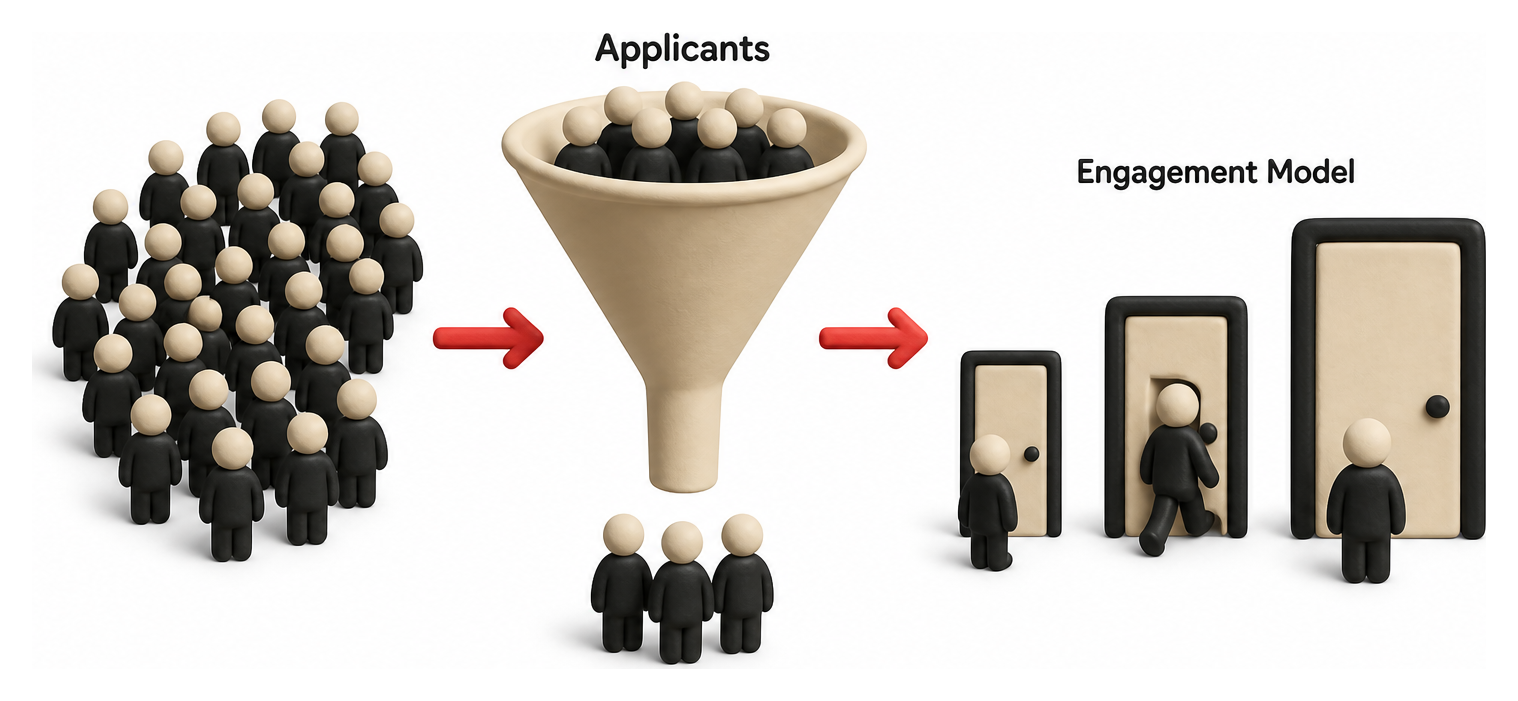
- Define the engagement model first. Before contacting any vendor, a company should determine whether it needs staff augmentation (a skills gap inside an existing team), a dedicated team (full ownership of a workstream), or a subscription/DaaS arrangement (continuous, variable-volume request handling). Analysts are explicit that these "are not interchangeable" [23], so the choice should match the work’s scope, continuity needs, and required level of control.
- Evaluate vetting rigor. Premium freelance and staffing platforms compete partly on the strength of their screening. Toptal, for example, states that "typically fewer than 3% are accepted" into its talent network after a process that "takes between 3 to 8 weeks" [49] [50]. A buyer evaluating any dedicated-team or subscription vendor should ask what proportion of applicants the vendor accepts and what its internal quality-control process looks like, since this is a reasonable proxy for consistency of output.
- Use a trial or pilot period. Toptal offers a "trial period of up to two weeks" before billing begins [51], reporting a 98 percent trial-to-hire conversion rate [52]; Penji separately backs new subscriptions with a 30-day money-back guarantee [60]. Any serious buyer should insist on an equivalent low-risk trial window rather than committing to a 12-month contract, such as Superside's Dedicated plan [6], sight unseen.
- Confirm intellectual property terms explicitly. Because default IP ownership varies by jurisdiction and contract structure, and freelancers "retain ownership of their work unless the contract clearly states otherwise" [38], buyers should require a written assignment-of-rights or work-made-for-hire clause modeled on the standard options AIGA's contract template lays out [53] before any design work begins, not after.
- Verify onboarding speed against the vendor's own claims. A vendor promising a "fully assembled pod with a Tech Lead" operational within two weeks [30] should be asked for named references who can confirm that timeline was actually met on a comparable engagement.
- Set a request-management process for subscription models. Since most subscription providers gate throughput by "active request" limits rather than headcount (Kimp, for instance, caps its Graphics plan at three active requests at a time [75]), buyers should map their expected monthly request volume against a provider's stated capacity before signing, to avoid a mismatch between expected and actual throughput.
- Decide on pricing model fit. Buyers with continuous, high-volume, predictable design needs are typically better served by a fixed monthly subscription; buyers with a single large initiative are often better served by a dedicated team billed on a defined-scope or hourly basis, at rates GoodFirms places between "$18 to $80 per hour" depending on seniority and location [39].
The broader outsourcing environment context matters here too. Deloitte's Global Outsourcing Survey found that 83 percent of respondents are "leveraging AI as part of their outsourced services" as of the 2024 survey [86], meaning buyers evaluating a dedicated design team in 2026 should also ask what role AI-assisted tooling plays in a vendor's production process, since this increasingly affects both speed and price.
How a Dedicated Design Team Speeds Up Product Launches
The mechanism by which a dedicated design team accelerates a launch is best understood through established product-development frameworks rather than vendor marketing claims alone. Google Ventures' well-documented Design Sprint methodology is built explicitly to "compress months of time into a single week" of validated decision-making before expensive engineering work begins [87], a compression that is only achievable when a team has enough dedicated design capacity to run the sprint without pulling designers off other active work, which is precisely the constraint a subscription or dedicated-team arrangement is built to remove.
Nielsen Norman Group's guidance on integrating user experience work into agile development describes the core workflow discipline that makes fast, design-supported shipping possible: teams should "have the user interface team progress one step ahead of the implementation team" [88], so that by the time engineers are ready to build a feature, the design and its usability testing are already complete. NN/g notes that this parallel-track loop, encompassing both design and lightweight testing, "you can do both in a week or two by using paper prototypes" [89], a cadence that is difficult to sustain without a design resource dedicated full-time to staying ahead of the build queue. A design director at Autodesk described the risk of not maintaining this separation bluntly: without a parallel design track, "development would be three sprints past that work" before the team even noticed design had fallen behind [90], illustrating the launch-delay risk that a dedicated, always-on design capacity is specifically meant to prevent.
Once shipped, design systems, an artifact a dedicated design team is well positioned to build and maintain because of its continuity, compound this speed advantage. Atlassian's own design-system engineering team documented that a refactor of its button and link components produced a 10 percent average reduction in client-side render times (Source: atlassian.design) and a 22 percent reduction in server-side rendering time (Source: atlassian.design), improvements that translate directly into faster-shipping, better-performing products across every team that consumes the shared component library. IBM's Carbon design system team reported that refining its own workflow and component quality drove "seven-fold growth in adoption within ten months" [91], with pages built on the shared system rising to represent "6.2% of all pageviews" on IBM's flagship site within roughly a year of the initiative [92], a proxy for how much internal shipping friction the shared design infrastructure removed as adoption spread. Research summarized in UXmatters ties this same dynamic directly back to commercial outcomes, describing organizations "leveraging design to drive business outcomes such as revenue and time to market" as a defined, measurable category of design maturity rather than an abstract aspiration [93].
The remote and distributed nature of most dedicated design team arrangements is not, on the available evidence, a productivity liability. Owl Labs' 2021 State of Remote Work survey of 2,050 U.S. workers found that 90 percent of respondents who worked from home during the pandemic reported being as productive or more productive than in an office [94], and 84 percent said working remotely after the pandemic would make them happier [95], a relevant data point since the large majority of dedicated design team engagements are conducted remotely or across time zones by design.
Data Analysis and Evidence
The market for outsourced and subscription-based design services sits inside a larger and fast-growing creative services economy. Mordor Intelligence values the global creative design services market at approximately $56.22 billion in 2026, projecting growth to $82.85 billion by 2031 at a compound annual growth rate of 8.06 percent ([96]%20%7C%20USD%2082.85%20Billion) [22]. A related but distinct Mordor Intelligence report on the narrower graphic design market puts that segment's 2026 size at $59.29 billion [97]. A third, faster-growing adjacent segment tracked by Fortune Business Insights, the global UX services market specifically, was valued at $6.40 billion in 2025 and is projected to reach $77.18 billion by 2034, implying a much steeper 31.2 percent compound annual growth rate as demand for dedicated user-experience expertise accelerates [98]. Readers should note these three figures use different market definitions and cannot be summed or directly compared; they are presented as independent estimates from separate methodologies, and the wide range between them ($6.4 billion for UX-specific services versus roughly $56 to $59 billion for the broader creative and graphic design category) is itself informative about how differently research firms scope "design" as a market.
Table 3 below collects the report's core quantitative findings in one place, spanning cost, hiring, and outcome data.
| Metric | Figure | Source |
|---|---|---|
| Median pay, combined web developers and digital designers category (BLS) | $95,380/year (2024) | [7] |
| Global median time-to-hire | 38 days | [10] |
| U.S. average cost-per-hire | $5,475 | [12] |
| Design-led firms' revenue growth premium | 32 percentage points higher than peers | [15] |
| Illustrative cost of a 4-month-overdue automotive launch | Approximately EUR 2 billion, assuming customers turn to competitors | [16] |
| Usability redesign improvement (NN/g) | 135% average metric improvement | [17] |
| Startup failure due to no market need | 42% (landmark CB Insights study) | [18] |
| Global creative design services market (2026) | $56.22 billion | ([96]%20%7C%20USD%2082.85%20Billion) |
| Outsourcing execs leveraging AI (Deloitte) | 83% | [86] |
McKinsey's research provides the single most rigorous, independently conducted evidence linking design investment to business performance. Its Design Index study tracked "the design practices of 300 publicly listed companies over a five-year period" [99] and found that top-quartile design performers achieved 32 percentage points higher revenue growth and 56 percentage points higher total shareholder returns than their industry peers, and increase revenue and shareholder returns "at nearly twice the rate" of median performers overall [100]. The same research is candid about how much room for improvement exists even among large public companies, finding that "over 40 percent of the companies surveyed still aren't talking to their end users" during development [101], a gap that dedicated design capacity, whether internal or outsourced, is specifically positioned to close since a full-time design resource has the bandwidth for user research that an overstretched founder or engineering-led team typically does not.
Elsewhere, Nielsen Norman Group's foundational return-on-investment research recommends "devoting about 10% of a project's budget to usability" activities [102], a rule of thumb that gives buyers a concrete anchor for how much of an overall product budget a dedicated design or research allocation should represent, and the group's broader dataset found redesign efforts improved target usability metrics "by 135% when we excluded five outliers" [17], a figure that should be read as an average across varied projects rather than a guaranteed outcome for any single redesign. A Forrester Consulting Total Economic Impact study of a UX research platform found a composite organization achieving a net present value of $7.6 million and a 415 percent return on investment with under six months' payback ([103]%20of%20%247.6%20million%20and%20an%20ROI%20of%20415%25), though this figure describes a single commissioned study of one platform's customers rather than an industry-wide average and should be treated accordingly.
On the risk side of the ledger, CB Insights' updated analysis of 431 venture-backed companies that shut down since 2023 found that "ran out of capital" tops the list of stated failure causes at 70 percent, though the same report cautions this is "almost always" a downstream symptom rather than a root cause [104], with the actual underlying drivers identified as "poor product-market fit (43%), bad timing (29%), and unsustainable unit economics (19%)" ([105]%2C%20bad%20timing%20(29%25)%2C%20and%20unsustainable%20unit%20economics%20(19%25)). This mirrors CB Insights' earlier, widely cited landmark study of 101 startup post-mortems, in which "no market need" was cited as a failure reason in 42 percent of cases, more than any other single factor [18], and a failure to pivot away from a flawed product or decision cited in 7 percent of post-mortems [106]. Both figures are frequently invoked, including by design-outsourcing vendors, as indirect evidence that faster, better-tested product design reduces existential business risk, though it is worth noting plainly that CB Insights' own research does not isolate design quality as a standalone variable; the connection between design speed and reduced product-market-fit risk is a reasonable inference from adjacent data, not a finding CB Insights itself makes explicitly.
Finally, on the outsourcing environment itself, Statista's tracking of remote work adoption found the global share of employees working primarily remotely rose "from 20 percent in 2020 to 28 percent by 2023" [107], with the technology sector reporting the highest concentration of any industry tracked, at 67 percent of employees working primarily remotely [108], a structural shift that has normalized the distributed, often cross-border working relationships that dedicated design teams and subscription providers depend on.
Case Studies and Real-World Examples
The following cases are drawn from vendor-published case studies and business press coverage; all are named, real engagements, though vendor-published cases should be read with the understanding that the vendor selected and framed the outcome being described.
Marqeta and Superside: A Times Square Campaign in Five Days
Fintech card-issuing platform Marqeta used Superside's on-demand creative team to produce a complete out-of-home advertising campaign for Times Square, with Superside reporting that its team "completed the entire 3D animation in 5 days" [19] and zero additional full-time hires required to execute the project, noted directly in the case study's summary metrics as "full-time hires required: 0" [109]. Marqeta's own creative director explained the underlying capacity problem the engagement solved, stating the internal team was "consistently operating at full capacity" before bringing in outside support [110].
Forter: Scaling Creative Volume Without Adding Headcount
Fraud-prevention company Forter used Superside to scale its creative production across events, motion graphics, and AI-assisted content "without adding headcount" [111]. Forter's brand design manager summarized the relationship as effectively an extension of the internal team, stating "Superside is my creative team's creative team" [112], a description that captures the core value proposition of the dedicated-team model: absorbing volume the internal team cannot handle without the internal team losing ownership of creative direction.
AcreMade: Handling Pre-Launch Design Volatility
Direct-to-consumer food startup AcreMade used Superside's on-demand design capacity specifically during its pre-launch phase, when creative needs were highly unpredictable. The company's own account states "on-demand was helpful to us because, throughout pre-launch, our needs fluctuated a lot" [113], and the case study reports the arrangement saved "more than 200 hours of production and project management time" [114] that would otherwise have gone toward staffing and coordinating a variable-demand creative workload internally.
Standout Authority and qBotica: Design Pickle's Turnaround and Cost Outcomes
Marketing agency Standout Authority reported cutting its own client-facing design turnaround times in half after adopting Design Pickle's dedicated design service, stating directly, "we've reduced our turnaround times in half" [115], while producing over 2,300 designs and saving more than $200,000 annually according to the case study's reported figures. Separately, automation firm qBotica reported saving over 25 hours per week after consolidating fragmented outsourced design work into Design Pickle's dedicated-designer model, with its chief marketing officer describing the prior fragmented approach as resulting in "painfully slow speed to market" before the switch [116], a direct testimonial tying design-team consolidation to launch-speed improvement rather than cost savings alone.
Big Sur AI: A Toptal Prototype That Helped Close $6.9 Million in Funding
AI e-commerce startup Big Sur AI engaged a Toptal-sourced UI designer and developer to build a working prototype quickly, with Toptal's case study crediting the engagement with "enabling $6.9M in funding and driving market growth" [117]. Big Sur AI's co-founder and chief executive stated the engagement "helped accelerate our time to raise funds by several weeks" [20], a concrete example of design work directly compressing a fundraising timeline rather than only a product-shipping timeline. In a separate Toptal case study, a technology entrepreneur used the platform's agile design and development resourcing to "launch 10 new consumer-facing products in less than a year" [118], illustrating how dedicated external design and development capacity can support a portfolio launch cadence that would be difficult to staff internally at the same pace.
Truebill and Puzzle: Ramotion's Brand and Product Design Impact
Personal-finance app Truebill engaged design agency Ramotion for branding and product design work during its growth phase; the company was later acquired by Rocket Companies for $1.275 billion, an acquisition Ramotion's own portfolio page cites as evidence of the relationship's business impact [119], with the redesign work contributing to the startup gaining 10,000 new users within a month of relaunch [120]. Separately, accounting platform Puzzle grew 15 percent month-over-month after Ramotion redesigned its dual-audience website user experience [121], with the platform now serving more than 2,300 businesses on the redesigned product [122].
Taken together, these cases span three types of external design capacity: Superside's on-demand subscription model, Toptal's vetted-freelancer marketplace, and Ramotion's traditional agency relationship. They report measurable speed, funding, or growth outcomes tied to bringing in outside design capacity rather than expanding an internal team, but they do not establish that each engagement used a dedicated design team as defined in this report. Readers should weigh these cases as illustrative rather than statistically representative, since all were selected and published by the vendors involved (or, in Ramotion's case, drawn from the agency's own portfolio materials) as evidence of their own effectiveness; no independent, vendor-neutral audit of these specific outcomes was located during this research.
Implications and Future Directions
Several forces are likely to reshape the dedicated design team category over the next several years. First, the tension Deloitte's data captures, between rising overall outsourcing investment (80 percent of executives plan to maintain or increase it) [123] and a simultaneous wave of selective insourcing (70 percent of executives report insourcing previously outsourced scope) [21], suggests the market is not moving uniformly toward more outsourcing but is instead becoming more deliberate about which functions belong internally versus externally. Design work with deep, ongoing brand-strategy implications is more likely to be pulled in-house over time, while high-volume, well-specified production work (asset variations, marketing collateral, routine UI screens) is more likely to remain with dedicated teams or subscription providers, consistent with the "outcome-based" contracting shift Deloitte also documents at 67 percent adoption [47].
Second, artificial intelligence is already deeply embedded in how dedicated design vendors operate, with 83 percent of surveyed outsourcing executives reporting AI use in outsourced services delivery [86]. This raises a genuine open question the available research does not yet answer definitively: whether AI-assisted production will primarily compress the turnaround times subscription vendors already advertise (potentially pushing 24 to 48 hour claims toward same-day delivery), or whether it will instead compress prices as production costs fall, or some combination of both. Given that roughly 400 design subscription competitors already existed as of early 2026 by Superside's own count [56], continued AI-driven cost compression seems more probable than a shortage of providers, and buyers should expect the category's pricing floor to keep declining even as enterprise-tier dedicated team pricing (Superside's $31,000-per-month effective Dedicated minimum, including its mandatory software fee, for example) remains anchored to named, senior human talent that is comparatively insulated from that pressure.
Third, commercial market-research forecasts project growth in the broader creative-design-services market through 2031 and in the UX-services segment through 2034 [22] [98]. Those projections are consistent with continued interest in external design capacity, but they do not establish that demand will outpace the supply of in-house hires or predict which engagement model will prevail. Finally, McKinsey's finding that over 40 percent of large public companies still are not engaging directly with end users during development [101] implies significant unmet demand for the kind of dedicated research and design capacity that a well-structured external team, freed from the recruiting and onboarding lag that constrains in-house hiring, is specifically positioned to supply quickly.
Frequently Asked Questions (FAQs)
What is a dedicated design team, in one sentence? It is a named or client-aligned group of designers, typically employed by a staffing vendor, that works exclusively or near-exclusively on one client's product on an ongoing basis, distinct from a single freelancer, a one-off agency project, or a shared-capacity design subscription [2].
What are the main benefits of a dedicated design team? The most commonly cited benefits are faster onboarding than direct hiring, roughly two weeks for a full pod versus over three months to build an equivalent in-house team [33] [30]; lower blended cost, often 40 to 60 percent below local in-house hiring [40]; and scalability, since headcount can flex with a contract change rather than a hiring or layoff cycle [34].
How does a dedicated design team differ from in-house design? In-house hiring offers deeper brand ownership and institutional memory but costs more ($6,000 or more per month fully loaded per vendor comparison data [9]) and takes far longer to establish (44 to 89 days to fill a role per SHRM data [11]) than engaging an external dedicated team.
How does a dedicated design team differ from a freelancer? A freelancer is typically a single individual engaged for defined tasks at an hourly rate ($10 to $39 per hour on Upwork [37]), with continuity, IP ownership defaults [38], and availability negotiated per engagement. A dedicated team provides ongoing capacity from a named or client-aligned group; a subscription may instead provide ongoing access to a shared pool, subject to its service terms.
How much does an unlimited design subscription cost? As of July 2026, published entry-level pricing ranges from $499 per month (Penji) [3] to roughly $700 to $2,600 per month for mid-market providers (ManyPixels) [64], up to $5,995 per month for solo-operator-style unlimited plans (DesignJoy) [42] and $15,000 to $30,000 per month for enterprise dedicated-team arrangements (Superside) [6].
How do I hire a dedicated design team? Define the engagement model needed first (staff augmentation, dedicated team, or subscription), evaluate the vendor's vetting rigor, insist on a trial or pilot period before a long-term commitment, and confirm intellectual-property terms in writing before work begins, following the process detailed in the hiring section above.
Can a dedicated design team actually speed up a product launch? Available evidence, both vendor case studies (a five-day Times Square campaign for Marqeta [19], a funding round accelerated by several weeks for Big Sur AI [20]) and independent process research (NN/g's parallel design-development tracking [88]) supports the claim, though the effect size varies substantially by project and is not independently quantified in a single, comprehensive study.
Conclusion
A dedicated design team occupies a distinct position between the high commitment of direct hiring and the low continuity of ad hoc freelance work. It should not be conflated with a design subscription: a dedicated arrangement supplies a named or client-aligned team, while a subscription may draw on a shared creative bench. Independent research associates strong company-wide design practices with better business performance, but it does not establish that hiring an external dedicated team causes faster launches [124]. The direct examples in this report of faster campaigns, fundraising, or growth are vendor-selected case studies, so they are illustrative rather than independently representative. Buyers should evaluate the actual engagement structure, continuity of assigned people, service capacity, intellectual-property terms, and evidence for outcomes before committing.
External Sources (124)
About
Tapflare
Tapflare in a nutshell Tapflare is a subscription-based “scale-as-a-service” platform that hands companies an on-demand creative and web team for a flat monthly fee that starts at $649. Instead of juggling freelancers or hiring in-house staff, subscribers are paired with a dedicated Tapflare project manager (PM) who orchestrates a bench of senior-level graphic designers and front-end developers on the client’s behalf. The result is agency-grade output with same-day turnaround on most tasks, delivered through a single, streamlined portal.
How the service works
- Submit a request. Clients describe the task—anything from a logo refresh to a full site rebuild—directly inside Tapflare’s web portal. Built-in AI assists with creative briefs to speed up kickoff.
- PM triage. The dedicated PM assigns a specialist (e.g., a motion-graphics designer or React developer) who’s already vetted for senior-level expertise.
- Production. Designer or developer logs up to two or four hours of focused work per business day, depending on the plan level, often shipping same-day drafts.
- Internal QA. The PM reviews the deliverable for quality and brand consistency before the client ever sees it.
- Delivery & iteration. Finished assets (including source files and dev hand-off packages) arrive via the portal. Unlimited revisions are included—projects queue one at a time, so edits never eat into another ticket’s time.
What Tapflare can create
- Graphic design: brand identities, presentation decks, social media and ad creatives, infographics, packaging, custom illustration, motion graphics, and more.
- Web & app front-end: converting Figma mock-ups to no-code builders, HTML/CSS, or fully custom code; landing pages and marketing sites; plugin and low-code integrations.
- AI-accelerated assets (Premium tier): self-serve brand-trained image generation, copywriting via advanced LLMs, and developer tools like Cursor Pro for faster commits.
The Tapflare portal Beyond ticket submission, the portal lets teams:
- Manage multiple brands under one login, ideal for agencies or holding companies.
- Chat in-thread with the PM or approve work from email notifications.
- Add unlimited collaborators at no extra cost.
A live status dashboard and 24/7 client support keep stakeholders in the loop, while a 15-day money-back guarantee removes onboarding risk.
Pricing & plan ladder
| Plan | Monthly rate | Daily hands-on time | Inclusions |
|---|---|---|---|
| Lite | $649 | 2 hrs design | Full graphic-design catalog |
| Pro | $899 | 2 hrs design + dev | Adds web development capacity |
| Premium | $1,499 | 4 hrs design + dev | Doubles output and unlocks Tapflare AI suite |
All tiers include:
- Senior-level specialists under one roof
- Dedicated PM & unlimited revisions
- Same-day or next-day average turnaround (0–2 days on Premium)
- Unlimited brand workspaces and users
- 24/7 support and cancel-any-time policy with a 15-day full-refund window.
What sets Tapflare apart
Fully managed, not self-serve. Many flat-rate design subscriptions expect the customer to coordinate with designers directly. Tapflare inserts a seasoned PM layer so clients spend minutes, not hours, shepherding projects.
Specialists over generalists. Fewer than 0.1 % of applicants make Tapflare’s roster; most pros boast a decade of niche experience in UI/UX, animation, branding, or front-end frameworks.
Transparent output. Instead of vague “one request at a time,” hours are concrete: 2 or 4 per business day, making capacity predictable and scalable by simply adding subscriptions.
Ethical outsourcing. Designers, developers, and PMs are full-time employees paid fair wages, yielding <1 % staff turnover and consistent quality over time.
AI-enhanced efficiency. Tapflare Premium layers proprietary AI on top of human talent—brand-specific image & copy generation plus dev acceleration tools—without replacing the senior designers behind each deliverable.
Ideal use cases
- SaaS & tech startups launching or iterating on product sites and dashboards.
- Agencies needing white-label overflow capacity without new headcount.
- E-commerce brands looking for fresh ad creative and conversion-focused landing pages.
- Marketing teams that want motion graphics, presentations, and social content at scale. Tapflare already supports 150 + growth-minded companies including Proqio, Cirra AI, VBO Tickets, and Houseblend, each citing significant speed-to-launch and cost-savings wins.
The bottom line Tapflare marries the reliability of an in-house creative department with the elasticity of SaaS pricing. For a predictable monthly fee, subscribers tap into senior specialists, project-managed workflows, and generative-AI accelerants that together produce agency-quality design and front-end code in hours—not weeks—without hidden costs or long-term contracts. Whether you need a single brand reboot or ongoing multi-channel creative, Tapflare’s flat-rate model keeps budgets flat while letting creative ambitions flare.
Disclaimer
This document is provided for informational purposes only. No representations or warranties are made regarding the accuracy, completeness, or reliability of its contents. Any use of this information is at your own risk. Tapflare shall not be liable for any damages arising from the use of this document. This content may include material generated with assistance from artificial intelligence tools, which may contain errors or inaccuracies. Readers should verify critical information independently. All product names, trademarks, and registered trademarks mentioned are property of their respective owners and are used for identification purposes only. Use of these names does not imply endorsement. This document does not constitute professional or legal advice. For specific guidance related to your needs, please consult qualified professionals.